
Combined Science or Pure Science: how to choose
A comparison of Combined and Pure Science for upper secondary in Singapore: what each covers, how they are examined, what they mean for junior college and polytechnic, and which students each one suits.
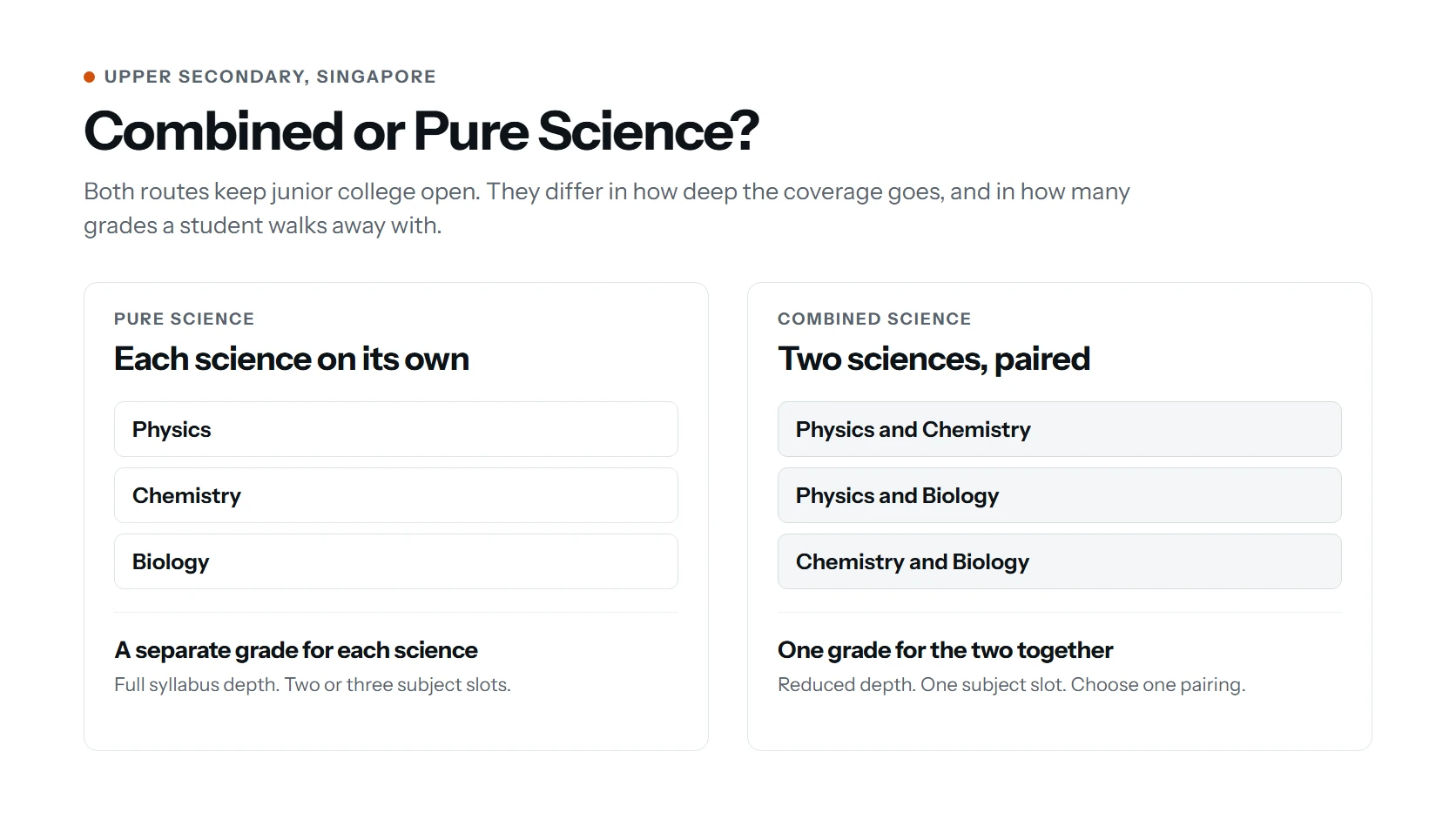
The choice between Pure and Combined Science is made near the end of Secondary 2. It is one of the few school decisions that genuinely widens or narrows what a student can do later. It is also made at an age when most students have no firm idea of what they want to study, so parents usually carry more of it than they do with other subject choices.
From 2027 these subjects sit within the Singapore-Cambridge Secondary Education Certificate instead of the O-Level, and are taken at G3. The structure of the choice has not changed.
The difference in one table
| Pure Science | Combined Science | |
|---|---|---|
| Subjects | Physics, Chemistry or Biology, each taken separately | Two sciences paired into one subject |
| Grades | One for each science taken | One grade for the pair |
| Depth | Full syllabus depth in each | Reduced depth across two |
| Timetable load | Two or three subject slots | One subject slot |
| Pairings | Not applicable | Physics with Chemistry, Physics with Biology, Chemistry with Biology |
| Suits | A student heading for H2 sciences, engineering, computing or medicine | A student whose strengths lie outside science, or who needs the timetable slot elsewhere |
What Pure Science gives
Pure Science is the direct route into H2 sciences at junior college. Each subject is studied at full depth and gets its own grade. A student who finishes Pure Chemistry has already met the ideas that H2 Chemistry builds on.
The cost is timetable space. Two or three science subjects take up slots that could hold a humanity, a second language or Additional Mathematics. For a student who is strong across all subjects, this is a reasonable trade. For a student who is already stretched, taking three Pure Sciences to keep options open can lower the aggregate that those same options depend on.
What Combined Science gives up
Combined Science covers two of the three disciplines at reduced depth and reports them as one grade. It is examined as a single subject: a multiple-choice paper across both sciences, a structured paper for each of the two, and a practical examination. The two structured papers carry most of the marks between them.
What matters is what this does and does not rule out. It does not rule out junior college. It does make the step into an H2 science larger, because the H2 syllabus assumes coverage that Combined did not provide. Students do bridge that gap, but the work happens alongside everything else in J1.
Polytechnic routes vary. Some courses ask for a particular science, and a Combined pairing may or may not meet that requirement. Check the specific course rather than assuming it either way.
How to decide
Decide on evidence rather than on ambition. Three questions, in this order.
- What do the Secondary 2 science marks show? Look at the marks, not the grade, and see whether marks are lost on recall or on explanation. A student losing marks on explanation will find Pure Science harder, and more revision alone will not fix it quickly.
- Is there a particular course in mind? If a course is genuinely in view and it needs H2 sciences, Pure is the easier route. If nothing specific is in view, keeping one science at Pure depth is usually better cover than taking three.
- What else does the timetable need? Additional Mathematics, a humanity at depth and a demanding second language all compete for the same slots. Good grades in a sensible combination open more doors than weak grades in an ambitious one.
The most common mistake is to treat Pure Science as the safe default. For a student whose strengths lie elsewhere, three Pure Sciences can cost more in the aggregate than the extra option is worth.
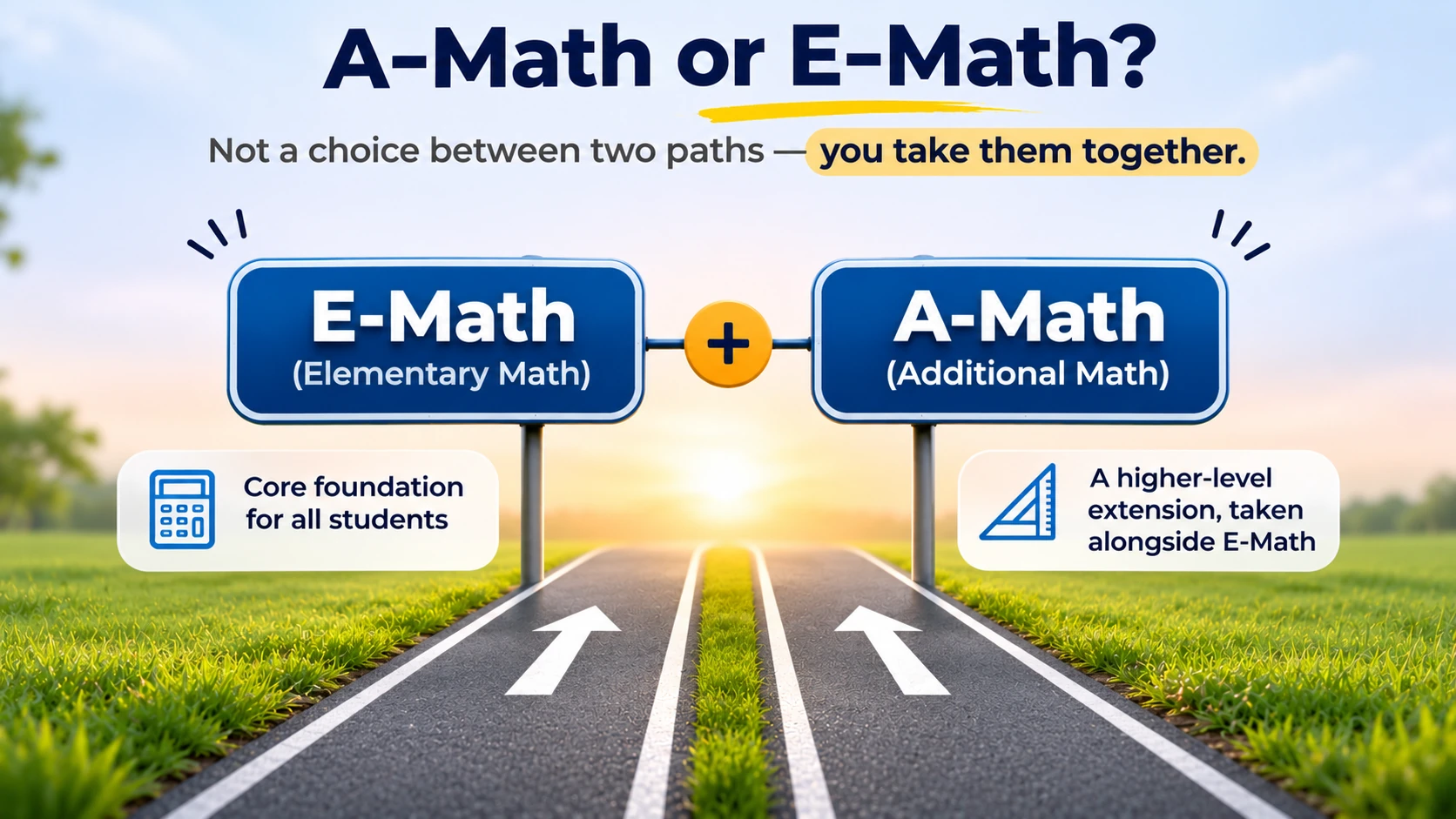
Our science tuition in Singapore follows the MOE syllabus and is taught by subject specialists, at whichever level a student is taking. A free trial class works from a marked paper, so the discussion afterwards is about where the explanation is breaking down. See also our guide to A-Math or E-Math, which is decided at the same point in the year, and PSLE Achievement Levels for families at an earlier stage.
Subject structures and syllabus documents are published by the Singapore Examinations and Assessment Board, and subject-based banding arrangements by the Ministry of Education. Confirm the current year’s details there before acting on any summary, including this one.
Questions parents ask
Does Combined Science close off junior college?
Is Combined Science easier?
Which Combined pairing should my child take?
How is Combined Science examined?
Can a student change after starting?
See where the explanation stops
Your child explains a topic they have just covered. Where the explanation runs out is the real starting point.
- Free, with no obligation
- A subject specialist, not a generalist
- Marked against the mark scheme
Book a free trial class.
Tell us your child's year group and what they are finding difficult. The last field matters most: a specific worry produces a better tutor match than a subject name.
- A live lesson, not a sales call
- A discussion of the curriculum and your expectations afterwards
- No card details, and nothing starts automatically
Request received
An advisor will email you to confirm a time in your time zone, usually within one working day.