
Science tuition for students in Singapore
From PSLE Science open-ended answering to Pure and Combined Science at secondary and H2 subjects at junior college.
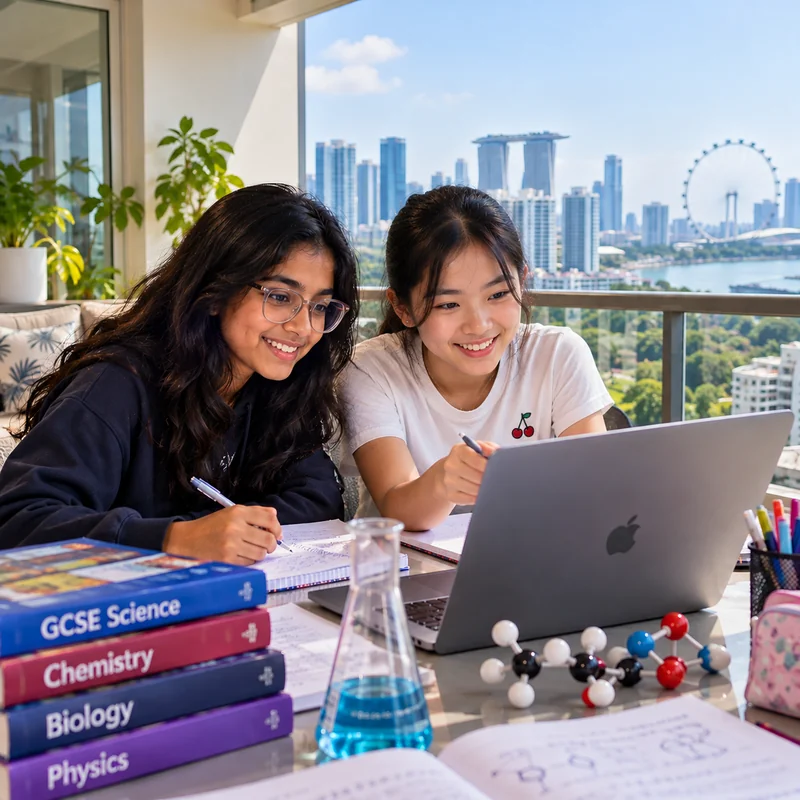
PSLE Science is marked on the explanation, not the recall
PSLE Science is one paper of a hundred marks: twenty-eight multiple-choice questions carrying fifty-six, and open-ended questions carrying forty-four. The open-ended booklet is where marks are lost. It asks a student to apply a concept to an unfamiliar scenario and to write an answer that states the concept, links it to the situation and reaches a conclusion. A correct idea expressed loosely does not score.
That is a writing skill attached to a science syllabus, and it is trainable. At secondary the structure changes again: students take Pure sciences as separate subjects or Combined Science as one, and the choice affects what junior college and polytechnic pathways assume later.
Science across every level group in Singapore
Tutors start from a diagnostic in the free trial, then teach what your child’s class is covering now. Examinations supported: PSLE Science, the Secondary Education Certificate sciences, and H1 and H2 A Level.
Primary 3-6
- Diversity of living and non-living things
- Cycles: matter, water and life cycles
- Systems: plant, human and electrical
- Energy forms and conversion
- Interactions and the environment
- Open-ended answering technique
- Process skills: observing, comparing, inferring
PSLE preparation
- Multiple-choice elimination technique
- Concept-link-conclusion answer structure
- Experiment and variable questions
- Graph and table interpretation
- Common misconception traps
- Time allocation across sections
- Booklet A and Booklet B mark allocation
Secondary, G1 to G3
- Pure Biology, Chemistry and Physics
- Combined Science pathways
- Chemical bonding, moles and reactions
- Forces, energy, electricity and waves
- Cells, transport, genetics and ecology
- Practical skills and planning questions
- Choosing Pure or Combined at Secondary 2
Junior college and international
- H1 and H2 Biology, Chemistry and Physics
- Data-based and structured questions
- Practical assessment skills
- Mathematical methods in physics and chemistry
- IB Diploma sciences
- Cambridge IGCSE sciences
- Science olympiads, on request
The real problem is rarely more practice
"She knows the science and loses open-ended marks."
The marks are for the structure of the answer: state the concept, link it to the scenario, then conclude. It is a format, and once it is explicit the same knowledge scores more.
"Should he take Pure or Combined Science?"
It depends on the pathway he wants after secondary, and the decision is easier with marked evidence than with a prediction. We will give you a read rather than an opinion.
"Physics at G3 is much harder than the science he did before."
The step is mathematical as much as conceptual. Rearranging formulae and handling units are taught here explicitly rather than assumed from maths lessons.
"There is a lot to memorise and he remembers none of it."
Because recall built by re-reading does not survive a question. Practice that requires retrieval and explanation is slower per topic and considerably more durable.
Teaching live online since 2010.
Every figure below comes from our own class records and can be verified on request.
How tuition runs for Singapore families
MOE syllabus at your child’s subject level, scheduled in Singapore time.
Free trial class
A real lesson with a subject specialist, and a read on which topics are genuinely weak rather than which ones feel hard.
Subject level check
We confirm the level your child takes each subject at, so the material is pitched where they are actually assessed.
Weekly slot in Singapore time
After school and weekends in SGT, with the same tutor each week.
Timed to the school’s own assessments
Parent-teacher meetings planned around the weighted assessments rather than arriving after them, with one on demand whenever you ask.
The same approach applies to every subject: our coaching methodology explains how a lesson is planned, marked and followed up. You can also see everything we teach in Singapore or read reviews from parents.
What families say about science
“I am happy to recommend Augment Edutech to anyone looking for Science tuition for their children. Their classes are well structured and the teachers are qualified and very competent. Overall value for money.”
USA
“The physics classes are great with Prakriti mam! My child gets lessons that fit their needs, and the teacher make things easy to understand. I recommend it if you want your child to do well in physics.”
USA
“Augment Edutech has really helped my child learn better. The teachers give each student attention and make science interesting. My child now understands things more easily and feels more confident.”
London
Pitched at the subject level your child actually sits
One lesson with a subject specialist at the right G level, then a discussion of which topics are genuinely weak.
- Free, with no obligation
- MOE syllabus at G1, G2 or G3
- Diagnostic, not general revision
Clear answers before you start
Do you follow the MOE science syllabus?
Do you teach PSLE Science open-ended technique?
Do you teach all three sciences at secondary?
Do you support H1 and H2 sciences at junior college?
How is PSLE Science structured?
Pure or Combined Science: what does the choice change?
Is there a practical component?
Do you prepare for the science olympiads?
Do you teach IB or IGCSE sciences?
Is tuition one to one?
When do classes run?
What if we have to miss a class?
How do we see progress?
What do we need at home?
Book a free science trial class.
Tell us your child's year group and what they are finding difficult. The last field matters most: a specific worry produces a better tutor match than a subject name.
- A live lesson, not a sales call
- A discussion of the curriculum and your expectations afterwards
- No card details, and nothing starts automatically
Request received
An advisor will email you to confirm a time in your time zone, usually within one working day.