
PSLE Achievement Levels explained
How PSLE Achievement Levels work: the eight AL bands and their mark ranges, how the four subject ALs add up to a PSLE Score of 4 to 32, how Foundation subjects convert, and what the score decides at secondary posting.
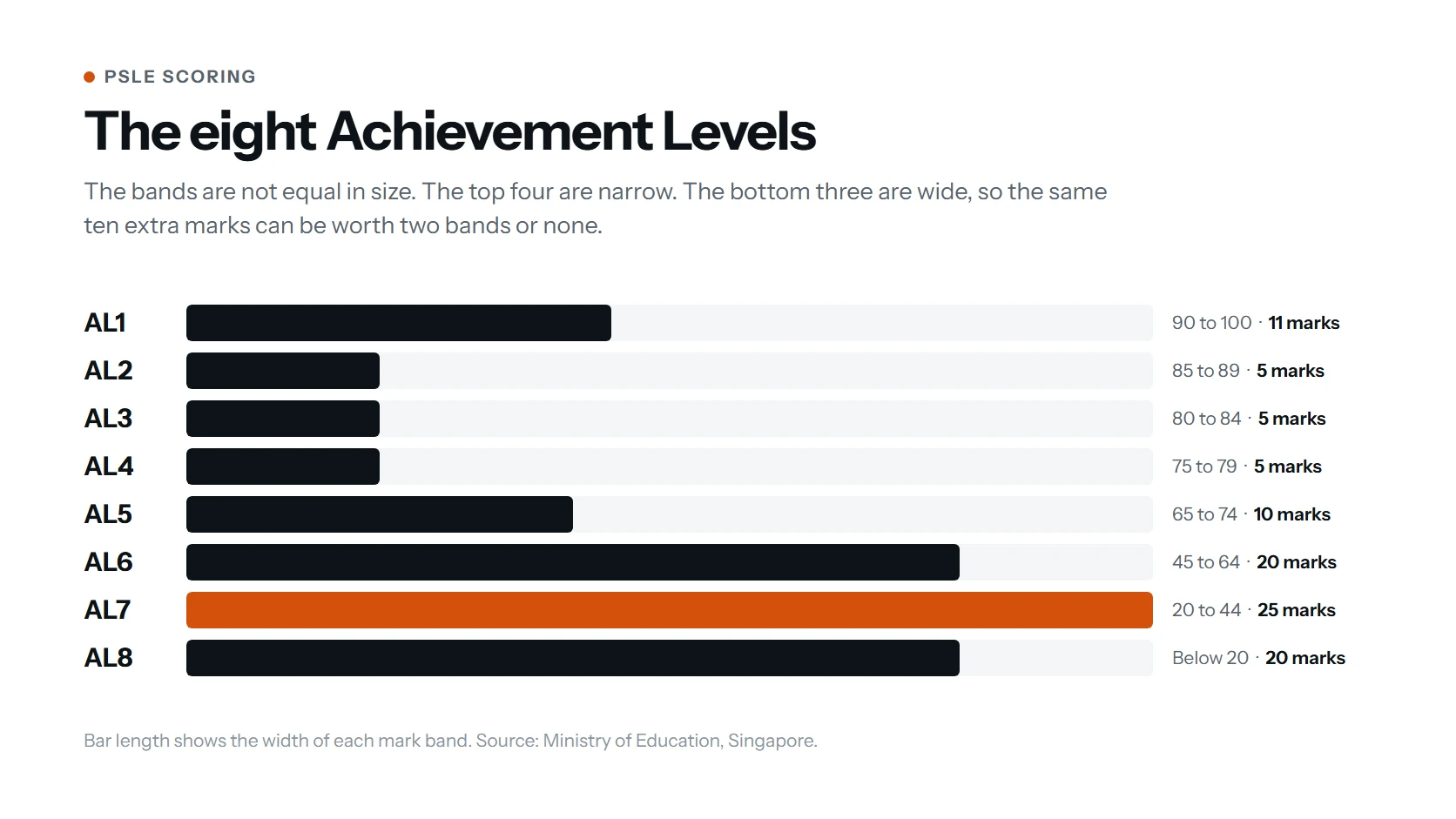
Singapore replaced the PSLE T-score with Achievement Levels in 2021. Under the T-score, a child’s result depended on how the rest of the cohort performed that year. Under Achievement Levels, a child is graded against fixed mark ranges. Two children who score 90 marks both get AL1, whatever anyone else scores.
So the question for parents has changed. It is no longer about where a child stands in the year group. It is about which band each subject falls into, and where within that band the marks sit.
The eight bands
Every Standard-level subject is reported as one of eight Achievement Levels. Each band covers a fixed range of marks.
| Achievement Level | Marks |
|---|---|
| AL1 | 90 to 100 |
| AL2 | 85 to 89 |
| AL3 | 80 to 84 |
| AL4 | 75 to 79 |
| AL5 | 65 to 74 |
| AL6 | 45 to 64 |
| AL7 | 20 to 44 |
| AL8 | Below 20 |
The bands are not equal in size. The top ones are narrow: five marks separate AL2 from AL3. The lower ones are wide. AL6 covers twenty marks and AL7 covers twenty-five.
This affects where revision time is best spent. Ten extra marks can be worth two bands or none, depending on where a child starts. A child who moves from 86 to 96 crosses two bands. A child who moves from 50 to 60 crosses none, even if the second child worked harder for it. For the same reason, a child at the bottom of a wide band has more ground to cover than the one-point gap in the total suggests. The mark sheet tells you more than the Achievement Level does.
How the four subjects add up
Each of the four subjects gives its own Achievement Level: English, Mother Tongue, Mathematics and Science. The four numbers are added. That sum is the PSLE Score.
The range is 4 at best, which is AL1 in all four subjects, to 32 at worst. A lower score is a better score, which takes some getting used to if you are thinking in percentages.
No subject is weighted more than another. A point gained in Mother Tongue counts the same as a point gained in Mathematics. Late in the year, this is useful to know. The subject closest to a band boundary is usually where an extra point is easiest to find, whichever subject that happens to be.
Foundation subjects
A child taking a subject at Foundation level is graded A, B or C. For posting, these grades convert to a Standard-level equivalent.
| Foundation grade | Marks | Counts as |
|---|---|---|
| A | 75 to 100 | AL6 |
| B | 30 to 74 | AL7 |
| C | Below 30 | AL8 |
The converted number goes into the PSLE Score. A Foundation A therefore adds the same six points as a Standard AL6.
What the score decides
The PSLE Score decides which posting group a student enters secondary school in: G1, G2 or G3. The total is what counts. No single subject decides it.
Secondary school cut-off points are not fixed in advance. They come out of the scores of the students who apply that year. Last year’s figures are a guide, not a guarantee.
Under Full Subject-Based Banding, the posting group is where a student begins. A student can take individual subjects at a higher level if their results support it. The posting group does not fix every subject a child will study.
Three things this means in practice
- Look at the mark, not only the band. An AL5 at 74 marks and an AL5 at 65 marks look the same on the certificate. They need very different work next. Ask for the paper.
- Look for band boundaries. Since the four levels are added together, the easiest point to gain is wherever a child sits closest to a boundary. This is often not the subject that feels weakest.
- Be patient with the wide bands. AL6 and AL7 each cover twenty marks or more. A child inside one of them can improve for months with no change in the grade. Judge progress on marked work during that time.
Our Singapore tutoring follows the MOE syllabus at a child’s own subject level. A free trial class begins with marked work rather than a placement test, so the discussion is about the marks behind the band. English, maths and science are each taught by a subject specialist.
Scoring rules and the current year’s arrangements are published by the Singapore Examinations and Assessment Board and the Ministry of Education. Where this page and an MOE publication differ, the MOE publication is correct.
Questions parents ask
What is a good PSLE score?
Is AL1 the same as an A star under the old system?
Does one weak subject spoil the total?
How do Foundation subjects count towards the total?
Does the PSLE score decide the posting group?



See the difference in one class
A free trial lesson with a specialist tutor, then a discussion of what the tutor found and your expectations.
- Free, with no obligation
- A tutor matched to the year and subject
- A recommendation you can act on
Book a free trial class.
Tell us your child's year group and what they are finding difficult. The last field matters most: a specific worry produces a better tutor match than a subject name.
- A live lesson, not a sales call
- A discussion of the curriculum and your expectations afterwards
- No card details, and nothing starts automatically
Request received
An advisor will email you to confirm a time in your time zone, usually within one working day.