
De-streamed Grade 9 in Ontario: MTH1W, SNC1W and the choice that follows
What de-streaming changed in Ontario Grade 9, what MTH1W and SNC1W cover, and why the real decision is the Grade 10 choice between MPM2D and MFM2P, made in the spring of Grade 9.
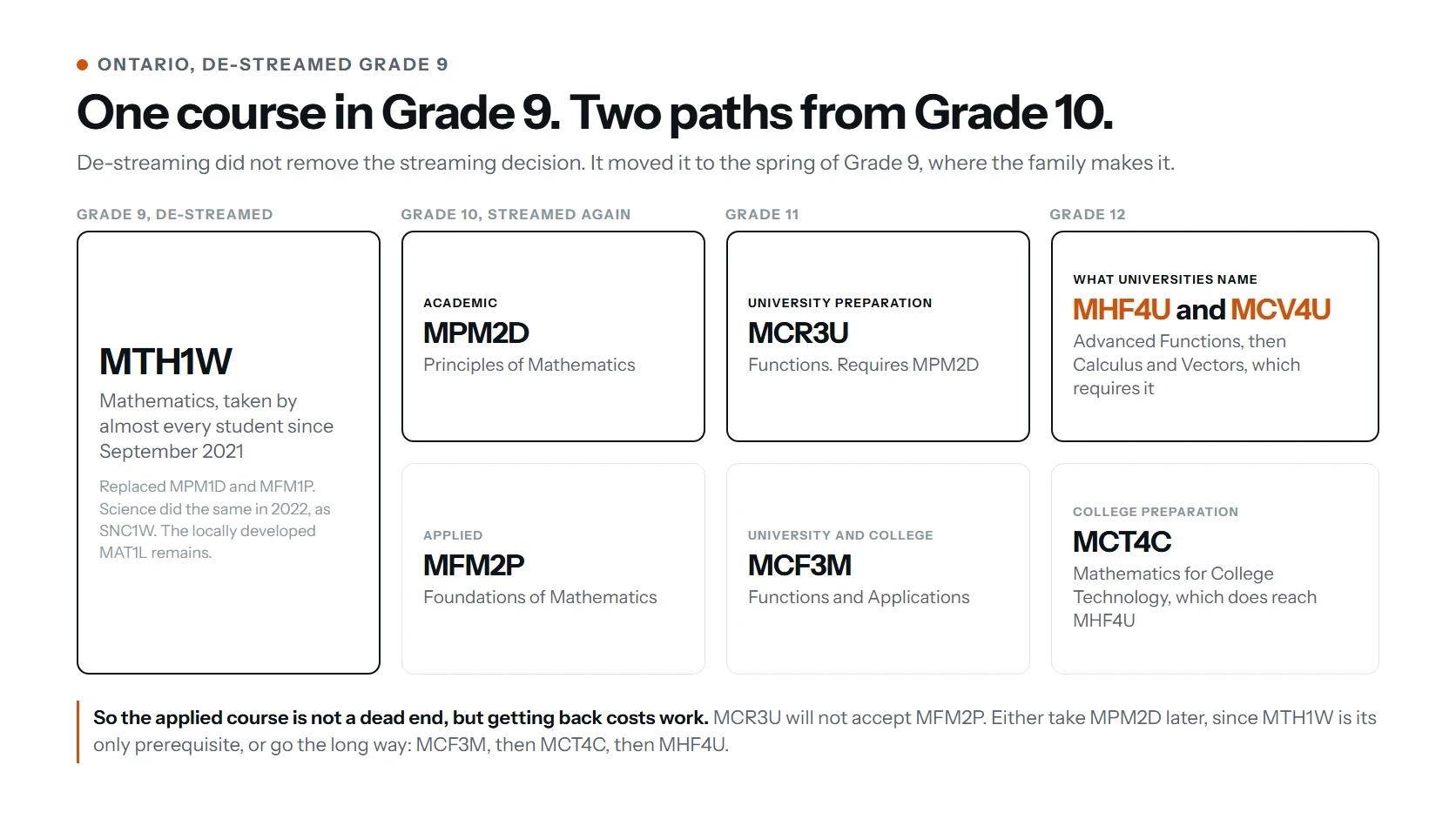
De-streaming is one of those changes that sounds bigger than it feels and then turns out to matter in a way nobody warned you about. If your child is in Grade 9 in Ontario, here is the part worth understanding: the streaming decision has not been removed. It has been moved to the spring of Grade 9, and it has been handed to you.
What actually changed
Two courses replaced four.
| Subject | Before | Now | From |
|---|---|---|---|
| Mathematics | MPM1D (academic) or MFM1P (applied) | MTH1W, taken by almost every student | September 2021 |
| Science | SNC1D (academic) or SNC1P (applied) | SNC1W, taken by almost every student | September 2022 |
Every Grade 9 compulsory course was de-streamed, not only these two: English, geography and French followed, with the new course content arriving on its own date in each subject.
The reason given by the province was that children were being sorted at thirteen, and the sorting was not neutral. Applied courses held a disproportionate share of Black, Indigenous and low-income students, and the outcomes followed: a Toronto District School Board figure cited at the time put the five-year graduation rate for students who took a Grade 9 applied course at around 40 per cent.
So the academic and applied split is gone from Grade 9. The locally developed courses, MAT1L and SNC1L, still exist for the small number of students on that pathway, but for almost every family Grade 9 is now one classroom. That part is genuinely different.
What MTH1W and SNC1W cover
MTH1W is organised into six strands. Strand A is Mathematical Thinking and Making Connections, which runs through everything else rather than being taught separately. The five content strands are Number, Algebra, Data, Geometry and Measurement, and Financial Literacy.
Financial literacy surprises parents, and it is genuinely examined.
SNC1W is organised the same way: Strand A is STEM Skills, Careers, and Connections, taught through the rest, and then four discipline strands.
| Strand | Subject | Broadly covers |
|---|---|---|
| B | Biology | Ecosystems, sustainability and human impact |
| C | Chemistry | Atoms, elements and chemical reactions |
| D | Physics | Electricity and its applications |
| E | Earth and Space Science | Space exploration, the solar system and the universe, the Sun and its effect on Earth |
One thing to note about MTH1W specifically. From the 2026 to 2027 school year the Grade 9 EQAO mathematics assessment carries a fixed 20 per cent of the MTH1W mark across Ontario, and serves as the written exam for the course. We have written about what EQAO tests and when it counts separately, because the weighting changed this year and most advice online is still out of date.
Grade 10 is still streamed
This is the part families miss.
Grade 10 mathematics is still offered as two courses, and so is Grade 10 science. Nothing above Grade 9 was de-streamed provincially, and no province-wide change has been announced.
| Grade 10 choice | Academic | Applied |
|---|---|---|
| Mathematics | MPM2D Principles of Mathematics | MFM2P Foundations of Mathematics |
| Science | SNC2D Science | SNC2P Science |
Both pairs accept MTH1W and SNC1W as the prerequisite. So the door is genuinely open either way at the end of Grade 9. That is the point of de-streaming.
One caveat worth checking locally. A few boards have extended de-streaming into Grade 10 on their own initiative. The Waterloo Region District School Board is the clearest case: most of its Grade 10 students now take academic courses only. If that is your board, the choice below may not be yours to make, which is good news. Ask the school which Grade 10 courses it actually runs.
But the choice is made during course selection, which most schools run in February or March of Grade 9. That is before the final MTH1W mark exists, and often before the EQAO assessment has even been written. Under the old system, your child’s Grade 9 course type had already signalled the Grade 10 course. Now there is no signal. There is only a conversation in February with a few months of marks to go on.
Why the mathematics choice is the serious one
Follow the mathematics path forward and you can see why.
MCR3U, the Grade 11 university functions course, requires MPM2D. A student who took MFM2P cannot enter MCR3U directly.
MCR3U is in turn the prerequisite for MHF4U, Advanced Functions. And MHF4U is itself the prerequisite for MCV4U, Calculus and Vectors, which must be taken either before MCV4U or alongside it. Those two Grade 12 courses are what competitive university programmes name. Engineering, computer science, commerce, the sciences: they ask for mathematics that sits three courses above the choice being made in February of Grade 9.
So MPM2D is the course that keeps options open. If there is any realistic chance of a university programme that needs mathematics, that is the course.
The applied path is not a dead end, but getting back costs work. There are two routes. The simpler one is to take MPM2D later, in summer school, night school or a subsequent year: its only prerequisite is MTH1W, so it stays available, and the student then joins MCR3U normally. The longer one is MCF3M in Grade 11, then MCT4C, which is an accepted prerequisite for MHF4U. Both work and students use both. Either way it has to be planned for rather than discovered in Grade 12.
Science is simpler but follows the same logic. SNC2D leads to the Grade 11 university sciences, SBI3U, SCH3U and SPH3U. SNC2P leads to Grade 11 college biology and the Grade 12 college sciences. If medicine, engineering, nursing or any science degree is on the table, the Grade 10 course is SNC2D. It does not cost anything either: SBI3C, the college biology, accepts SNC2D as well, so the academic course keeps both routes open.
Further on, the same families then face the Grade 12 mathematics choice between MHF4U, MCV4U and MDM4U.
What to do during Grade 9
The honest summary: Grade 9 is now the year that decides, and it decides early.
- Treat the early work as the evidence. By February you and the school will be choosing on the basis of a few months of marked work, and if your child has mathematics in semester two, on Grade 8 work and other subjects instead. There is no second data point. A child who is shaky in October and left alone until April has made the decision by default.
- Watch algebra in particular. Grade 10 academic mathematics is where algebraic fluency stops being optional. A student who can get through MTH1W on arithmetic sense and good effort will feel the difference in MPM2D within weeks. That gap is visible in Grade 9 if anyone looks for it.
- Default to the academic course and support it. This is the practical advice. MPM2D and SNC2D keep every path open, and a student who finds them hard can be helped. A student placed in the applied course because Grade 9 felt difficult has lost a year that is hard to get back.
- Ask the school directly what they would recommend and why. The teacher has seen the marked work. Ask for the reasoning, not just the recommendation, because the reasoning is what you can act on.
One more thing about Grade 10
From the 2026 to 2027 school year Ontario has a financial literacy graduation requirement, and it lands in Grade 10. Students who entered Grade 9 in 2025 to 2026 or later must score at least 70 per cent on a standardised financial literacy test to earn the diploma. It sits in the Career Studies course, GLC2O, not in the mathematics course, which is where most people assume it would be. Students get two attempts within the course and further attempts outside it if needed.
It does not affect the MPM2D or MFM2P decision. It is simply a second thing in the Grade 10 year that is new and that nobody has told you about.
Getting help
Our math tutoring for Canadian students follows the Ontario curriculum, including MTH1W and the Grade 10 courses that follow it, and our science tutoring covers SNC1W and SNC2D. The full range for Ontario families is on the Canada tutoring page.
A free trial class starts with your child’s own marked work, so the outcome is a specific answer about which topic is costing marks, which is exactly what the February conversation needs.
Course codes, prerequisites and the full curriculum documents are published by the Ontario Ministry of Education. Confirm your own school’s course selection dates with the school, since boards set them individually.
Questions parents ask
What does de-streamed mean in Ontario Grade 9?
Is Grade 10 also de-streamed?
Does MFM2P close the door to university?
Which Grade 10 science course does my child need?
When is the Grade 10 choice actually made?


See the difference in one class
A free trial lesson with a specialist tutor, then a discussion of what the tutor found and your expectations.
- Free, with no obligation
- A tutor matched to the year and subject
- A recommendation you can act on
Book a free trial class.
Tell us your child's year group and what they are finding difficult. The last field matters most: a specific worry produces a better tutor match than a subject name.
- A live lesson, not a sales call
- A discussion of the curriculum and your expectations afterwards
- No card details, and nothing starts automatically
Request received
An advisor will email you to confirm a time in your time zone, usually within one working day.