
EQAO explained: what is tested, and when it counts
The four EQAO assessments in Ontario: Grade 3, Grade 6, Grade 9 mathematics and the Grade 10 literacy test. What each covers, how results are reported, and why the Grade 9 assessment now carries 20 per cent of the MTH1W course mark.
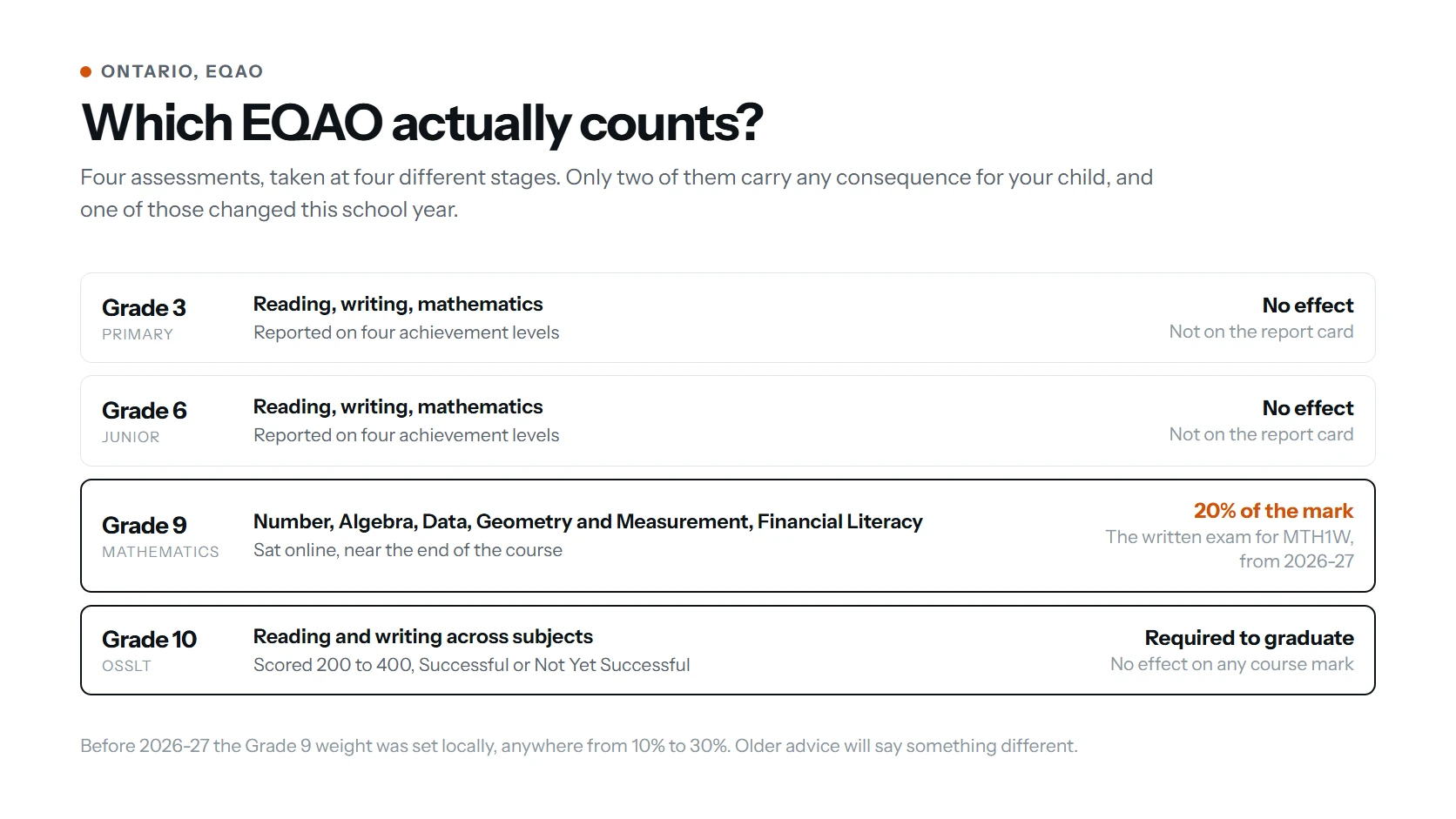
Ontario parents hear about EQAO every year and rarely get a straight explanation of what it is for. There are four assessments, they are taken at different stages, and only two of them have any direct consequence for your child. Knowing which is which saves a great deal of unnecessary worry.
The four assessments
| Assessment | Year | Covers | Affects your child |
|---|---|---|---|
| Primary Division | Grade 3 | Reading, writing, mathematics | No. Does not appear on the report card |
| Junior Division | Grade 6 | Reading, writing, mathematics | No. Does not appear on the report card |
| Assessment of Mathematics | Grade 9 | Number, Algebra, Data, Geometry and Measurement, Financial Literacy | Yes. 20% of the MTH1W mark from 2026-27 |
| OSSLT, the literacy test | Grade 10 | Reading and writing across subjects, to the end of Grade 9 | Yes. Required for the diploma |
The four levels
The Grade 3, Grade 6 and Grade 9 assessments report on the same four achievement levels used on the Ontario report card.
Level 3 is the provincial standard. Levels 3 and 4 together count as meeting that standard. So Level 3 is the target, and Level 4 sits above it. One exception: the Grade 10 literacy test does not use these levels. It is reported from 200 to 400, with 300 as the standard, and the result is Successful or Not Yet Successful.
This is worth explaining to a child before results arrive. Level 2 is not a failure, and the assessments are not pass or fail at all in Grades 3, 6 and 9. They report where a child stands against the provincial expectation.
The Grade 9 assessment is the one that counts
This is the part most families do not know, and it changes how seriously the year should be taken.
EQAO states that the results of the Grade 9 Assessment of Mathematics “are to be included as part of a student’s final course mark”, in line with the Ministry’s Growing Success policy. It is not a standalone test sitting outside the course. It forms part of the mark for MTH1W, the de-streamed Grade 9 mathematics course that every student now takes.
From the 2026 to 2027 school year the weight is fixed at 20% across Ontario, and the assessment serves as the written exam for MTH1W. That is a change. In 2024 to 2025 and 2025 to 2026, schools and boards set the weight themselves anywhere between 10% and 30%, which is why older guidance, and a good deal of advice still online, gives a different figure or tells you to ask the school. For this year the figure is province-wide.
A fifth of the course mark, decided on one morning, is worth knowing about in September rather than May.
It is taken near the end of the course, online, in one of two windows. For 2026 to 2027 those run in January and February, and again in June. The school chooses its own dates inside the window.
The five strands are Number, Algebra, Data, Geometry and Measurement, and Financial Literacy. Financial literacy surprises some parents, and it is genuinely examined.
The Grade 10 literacy test is a graduation requirement
The OSSLT does not affect any course mark. It is a requirement for the Ontario Secondary School Diploma, which makes it more serious than a mark, not less.
It tests reading and writing across subjects, at the standard expected by the end of Grade 9. It is also reported differently from the other three: a scale score from 200 to 400, where 300 meets the standard, and a result of Successful or Not Yet Successful rather than an achievement level.
A student who is unsuccessful normally writes it again. The literacy course, OSSLC, is the alternative route to the requirement, but it is not a free choice from the start. A student becomes eligible once they have been eligible to write the test at least twice and have been unsuccessful at least once, and a principal may allow it earlier where that is in the student’s best interest. Nobody is left without a path, but it does need to be dealt with rather than ignored.
How to prepare, and how not to
The assessments test the curriculum your child has been taught during the year. There is no separate EQAO syllabus to learn.
So drilling past papers is mostly wasted effort. What helps:
- Keep the year’s work secure as it goes. A child who understood the Grade 9 material in October does not need rescuing in May. The gap to close is the ordinary one, found in marked class work.
- Let them see the format once. The Grade 9 assessment is online, and a student meeting the interface for the first time on the day loses marks to the tool rather than the mathematics. EQAO publishes sample questions.
- Say plainly what it is. A child who thinks this is a pass or fail examination will perform worse than one who understands it reports an achievement level.
Getting help
Our math tutoring for Canadian students follows the Ontario curriculum, including the de-streamed Grade 9 course and the strands the EQAO assessment covers. A free trial class starts with marked work, so you find out which specific topic is costing marks rather than receiving a general report. For literacy ahead of the Grade 10 test, see our English tutoring, and the full range is on the Canada tutoring page.
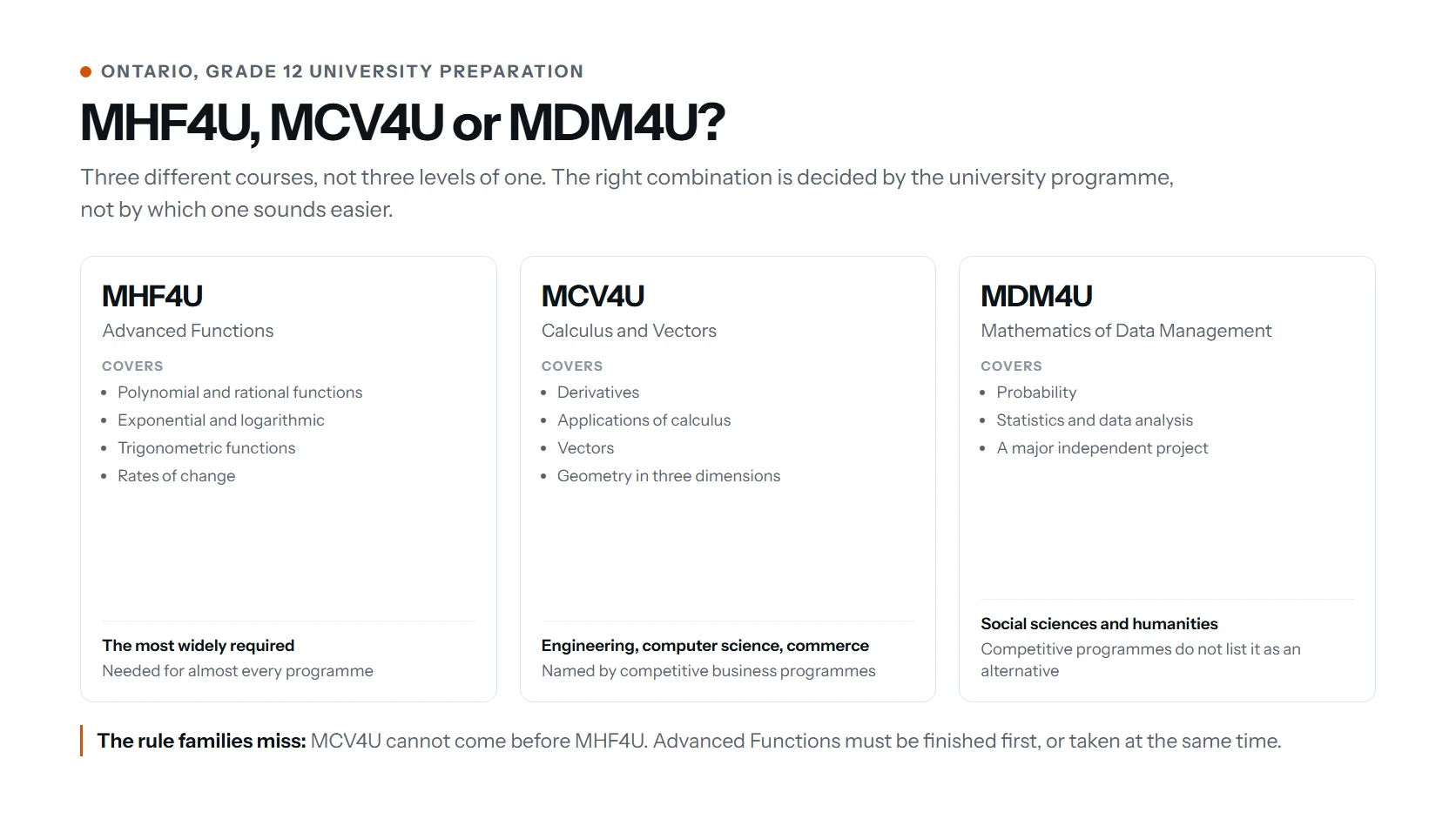
Families whose children are further on usually face the Grade 12 mathematics choice next.
Assessment details, dates and sample questions are published by EQAO, and the assessment policy behind the course mark in the Ministry’s Growing Success document at Ontario Ministry of Education. Confirm the weighting with your child’s school.
Questions parents ask
Does EQAO count towards my child's marks?
What is a good EQAO result?
Can my child fail EQAO?
When is the Grade 9 assessment taken?
Should we prepare for EQAO?
Find the missing prerequisite
A tutor works backwards until they find the last thing that is secure, then tells you where teaching should start.
- Free, with no obligation
- A diagnostic, not a sample lesson
- The gap named in writing
Book a free trial class.
Tell us your child's year group and what they are finding difficult. The last field matters most: a specific worry produces a better tutor match than a subject name.
- A live lesson, not a sales call
- A discussion of the curriculum and your expectations afterwards
- No card details, and nothing starts automatically
Request received
An advisor will email you to confirm a time in your time zone, usually within one working day.