
AP Calculus AB or BC: how to choose
What separates AP Calculus AB from BC: one semester of college calculus against two, the extra BC topics, the AB subscore that BC students also receive, and how to decide which course suits your child.
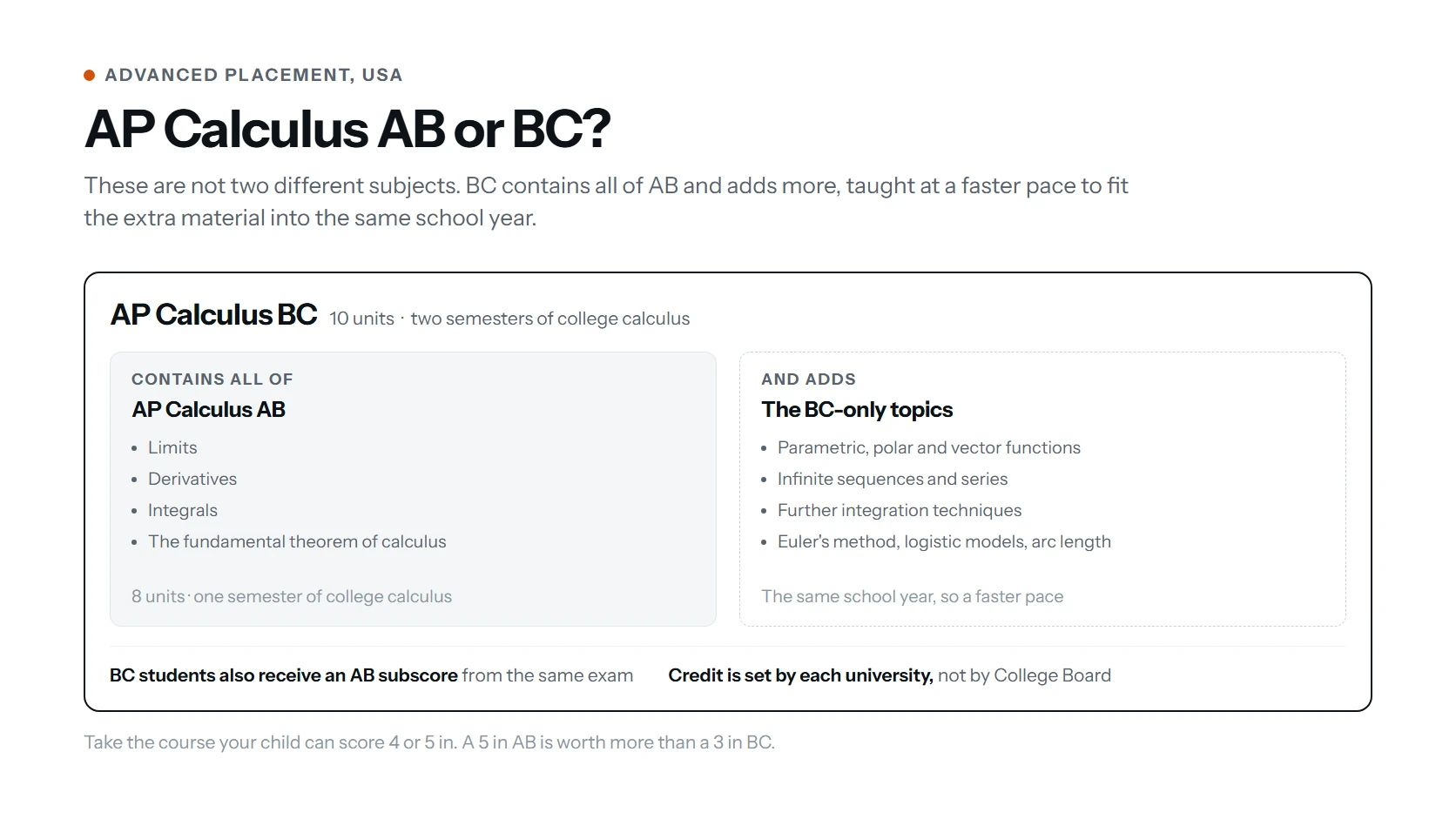
AP Calculus AB and BC are not two different subjects. BC contains all of AB and adds more. Understanding that makes the decision much simpler than it first appears.
The difference in one table
| AP Calculus AB | AP Calculus BC | |
|---|---|---|
| Equivalent to | One semester of college calculus | Two semesters of college calculus |
| Units in the course | 8 | 10 |
| Shared content | Limits, derivatives, integrals, the fundamental theorem of calculus | All of the AB content |
| Additional content | None | Parametric, polar and vector functions, infinite sequences and series, further integration techniques, and some BC-only material inside the shared units: Euler’s method, logistic models and arc length |
| Pace | Steady | Faster, because more content fits into the same year |
| Extra score given | None | An AB subscore as well as the BC score |
| Usual college credit | Calculus I | Calculus I and II |
The pace is the real difficulty
The extra topics are not harder in themselves. Sequences and series are new and some students find them strange at first, but they are not beyond a student who has managed the rest.
The actual challenge is speed. BC fits two semesters of college content into one school year. A student who needs time to sit with a new idea before it settles will struggle with that pace, even if they could handle every individual topic given more time.
So the honest question is not “is my child clever enough for BC”. It is “does my child learn fast enough to keep up with BC without losing their grip on the basics”.
The AB subscore
A student who sits the BC exam receives two results: the BC score, and a separate AB subscore graded from 1 to 5. It is based on the AB portion of the paper, which College Board puts at roughly 60% of the exam.
This provides a genuine safety net. A student who finds the BC pace difficult can still demonstrate solid AB-level calculus from the same exam. College Board goes further and recommends that colleges treat the AB subscore the same way they would treat an AP Calculus AB score, because the shared topics are tested at the same level in both exams. Colleges still set their own policy, so check it where your child is applying.
One rule follows from this and families should know it: a student cannot sit both the AB and BC exams in the same year. The two papers run at the same date and time. The subscore exists precisely so that sitting both is unnecessary.
The subscore is a safety net, not a reason to attempt BC unprepared. A student who is clearly not ready will get a weak BC score and a weak subscore together.
How to decide
- Look at precalculus, closely. Secure algebra and trigonometry is what makes BC manageable. A student who is still slow with trigonometric identities or algebraic manipulation will find the BC pace punishing, because every new topic rests on that foundation.
- Ask what the intended degree needs. Engineering, physics, mathematics, economics at many universities, and most data-heavy courses expect calculus beyond one semester. For those, BC saves a semester. For biology, most health sciences and non-quantitative degrees, AB done well is usually plenty.
- Check the credit policy where your child is applying. This is the step most families skip. Credit is set by each university and varies widely. At some, a 4 in BC earns two courses of credit. At others it earns one. The assumption that BC always pays off is not safe.
- Count the rest of the year. BC alongside three other demanding AP courses is a heavy load. Strong results in a sensible combination beat average results in an ambitious one.
The sensible rule: take the course your child can score 4 or 5 in. A 5 in AB is usually worth at least as much as a 3 in BC and often more, and it is a far better year. Be careful with the detail, though. At some universities a 3 in BC earns exactly the same Calculus I credit as a 5 in AB, and a BC 3 also carries an AB subscore alongside it. This is another reason to read the policy where your child is applying rather than follow a rule of thumb.
Where students lose marks
In both courses, the common pattern is the same. Students can perform the procedures and cannot explain them. The exams ask for justification, for correct notation, and for an interpretation of what an answer means in context. This is not a small share of the marks: in the free-response section, justifying reasoning and solutions accounts for between 35% and 60% of the assessment, against only 10% to 20% of the multiple-choice section.
In BC specifically, two areas regularly cost marks. One is series convergence, where choosing the right test and saying why it applies is a different skill from carrying out the test. The other is polar curves, which on the 2025 exam scored lower than the series question did. Both reward practice on justification rather than on more differentiation.
Our math tutoring for US students is taught one to one against the AP course framework, at whichever level a student is taking. A free trial class starts with a marked paper, so the conversation afterwards is about the specific skill losing the marks, which is usually justification rather than calculation. Where calculus is being taken alongside AP Physics C, the two can be taught together. The full range for American students is on our USA tutoring page.
Course frameworks, unit lists and current exam formats are published by College Board. Credit policies are published by each university. Check both before deciding.
Questions parents ask
Is BC simply AB plus more topics?
What is the AB subscore?
Which one gives more college credit?
Should a strong student always take BC?
Can a student take AB and then BC?


Find the missing prerequisite
A tutor works backwards until they find the last thing that is secure, then tells you where teaching should start.
- Free, with no obligation
- A diagnostic, not a sample lesson
- The gap named in writing
Book a free trial class.
Tell us your child's year group and what they are finding difficult. The last field matters most: a specific worry produces a better tutor match than a subject name.
- A live lesson, not a sales call
- A discussion of the curriculum and your expectations afterwards
- No card details, and nothing starts automatically
Request received
An advisor will email you to confirm a time in your time zone, usually within one working day.