
A-Math or E-Math: how to choose
A comparison of Additional Mathematics and Elementary Mathematics in Singapore: what each one covers, why A-Math is effectively the entry requirement for H2 Mathematics, and what the Secondary 2 marks tell you.
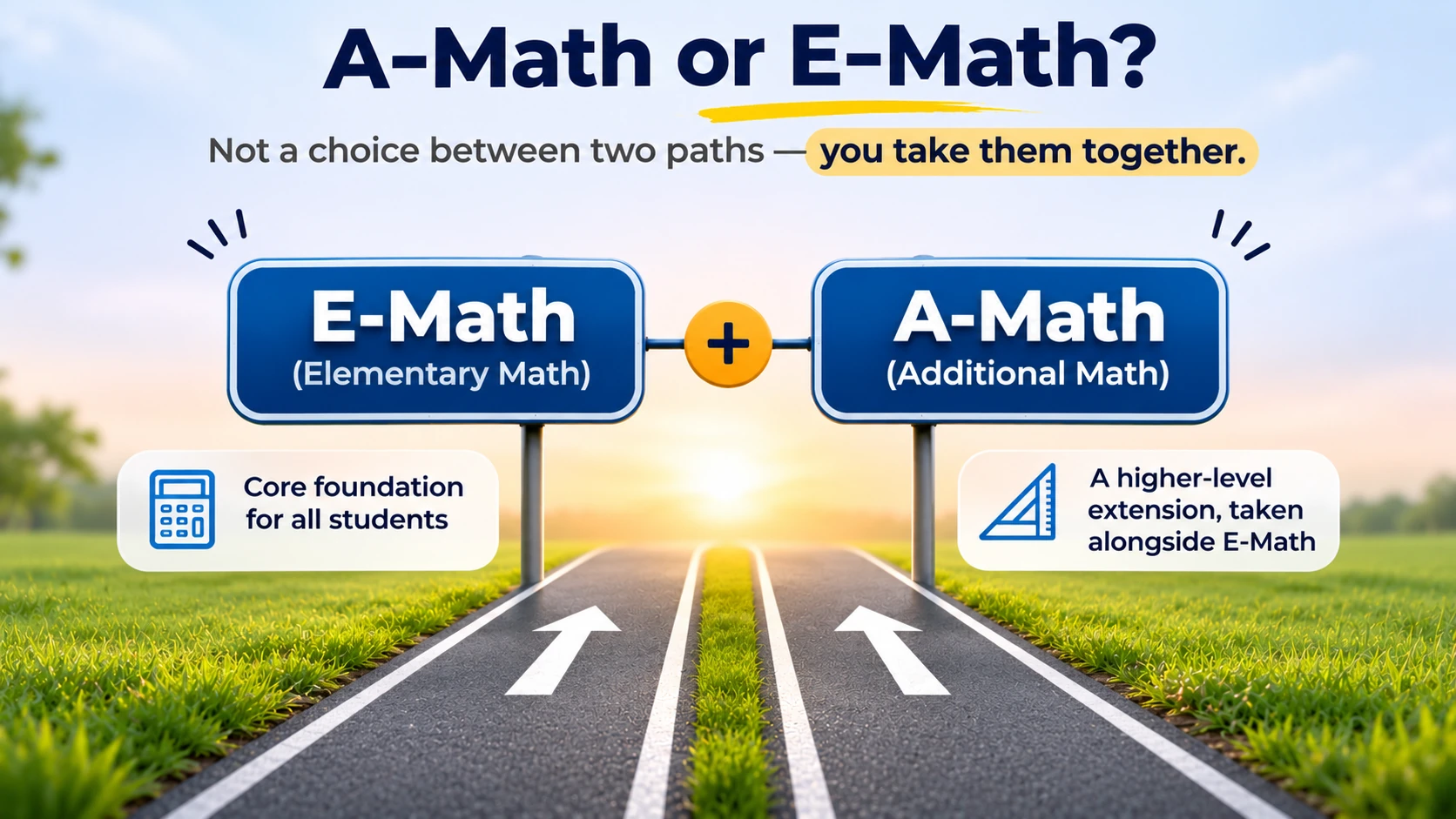
Additional Mathematics is an elective. It is taken along with Elementary Mathematics, not instead of it. A student who takes it sits both papers and receives two grades. So the question is not which mathematics to study. It is whether to carry a second mathematics subject through upper secondary.
From 2027 both subjects sit within the Singapore-Cambridge Secondary Education Certificate at G3. The content, the level of difficulty and the paper format carry over from the O-Level syllabuses they replace. G3 Mathematics is the former E-Math, and G3 Additional Mathematics is the former A-Math.
What each subject is for
| Elementary Mathematics | Additional Mathematics | |
|---|---|---|
| Taken by | Every student at this level | An elective, taken in addition |
| Purpose | Practical, applied numeracy | Foundations for later study |
| Calculus | Not covered | Differentiation and integration, with applications |
| Other main content | Statistics, mensuration, applied problems | Binomial expansion, advanced trigonometric identities, exponentials and logarithms, partial fractions, coordinate geometry of circles, proofs in plane geometry |
| Amount of algebra | Moderate | Almost everything |
| Enough for H2 Mathematics | No | Treated as assumed knowledge |
The H2 Mathematics question
Additional Mathematics is in practice the entry requirement for H2 Mathematics at junior college. The A-Math syllabus is written to prepare students for it, and the H2 syllabus assumes that preparation has been done.
A student can be admitted to H2 Mathematics without A-Math. What they cannot do is skip the material. Differentiation, integration, logarithms and the rest are treated as known, in a course that moves quickly. Covering them while keeping up with the rest of J1 is possible and it is hard.
H2 Mathematics in turn supports engineering, computing, the physical sciences, economics at several universities and most data-heavy degrees. So a decision taken in Secondary 2 reaches quite far forward. That is the strongest reason to take A-Math when a student can carry it.
The case against taking it
A second mathematics subject takes a timetable slot and a large share of a student’s working week. For a student whose strengths are in languages or the humanities, carrying A-Math can pull down the aggregate that their chosen course depends on.
There is one failure pattern worth naming. A-Math is almost entirely algebraic. A student whose algebra is weak does not only find A-Math hard. The time it takes often starts to damage the Elementary Mathematics grade as well, because the weakness is in the foundation both subjects share.
How to decide
- Read where the Secondary 2 marks are lost, not the grade. Marks lost on algebraic manipulation are the warning sign. Marks lost on arithmetic slips or on misreading the question are not, and those usually improve.
- Check whether anything later needs H2 Mathematics. If a field is genuinely in view and it does, that settles the question as far as it can be settled at this stage.
- Count the full load honestly. A-Math with three Pure Sciences is a heavy combination. Good grades in a sensible set of subjects open more doors than average grades in an ambitious set.
- Fix the algebra first if it is weak. This is the one case where a term of focused work before the decision can change the decision. Secure algebra is what makes A-Math manageable.
Our maths tuition in Singapore follows the MOE syllabus at a student’s own level. A free trial class begins with a marked paper, so the discussion afterwards is about which specific skill is failing. Where algebra is the gap, teaching starts there.
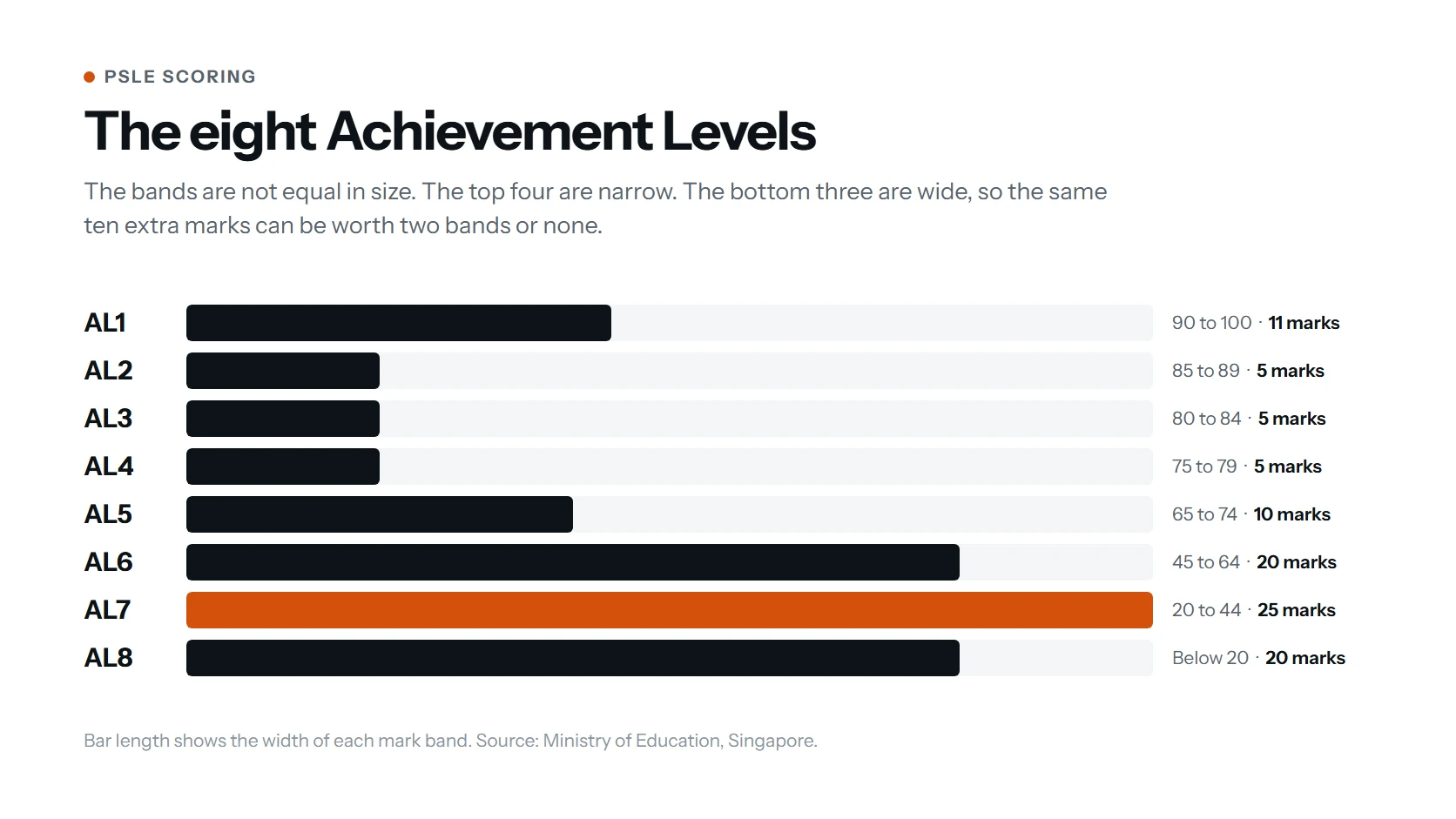
Families making this decision are usually making the Combined or Pure Science choice in the same term. The PSLE Achievement Levels guide covers the stage before this one.
Syllabus documents and current assessment arrangements are published by the Singapore Examinations and Assessment Board. Check there before acting on any summary, including this one.
Questions parents ask
Is A-Math compulsory?
Can my child do H2 Mathematics without A-Math?
What does A-Math cover that E-Math does not?
What Secondary 2 result suggests A-Math is sensible?
Does dropping A-Math later harm a student?

Find the missing prerequisite
A tutor works backwards until they find the last thing that is secure, then tells you where teaching should start.
- Free, with no obligation
- A diagnostic, not a sample lesson
- The gap named in writing
Book a free trial class.
Tell us your child's year group and what they are finding difficult. The last field matters most: a specific worry produces a better tutor match than a subject name.
- A live lesson, not a sales call
- A discussion of the curriculum and your expectations afterwards
- No card details, and nothing starts automatically
Request received
An advisor will email you to confirm a time in your time zone, usually within one working day.