
AP Physics 1 or AP Physics C: how to choose
The difference between AP Physics 1 and AP Physics C: the calculus requirement, the mechanics prerequisite for Electricity and Magnetism, what each course covers, and which suits a student heading for engineering.
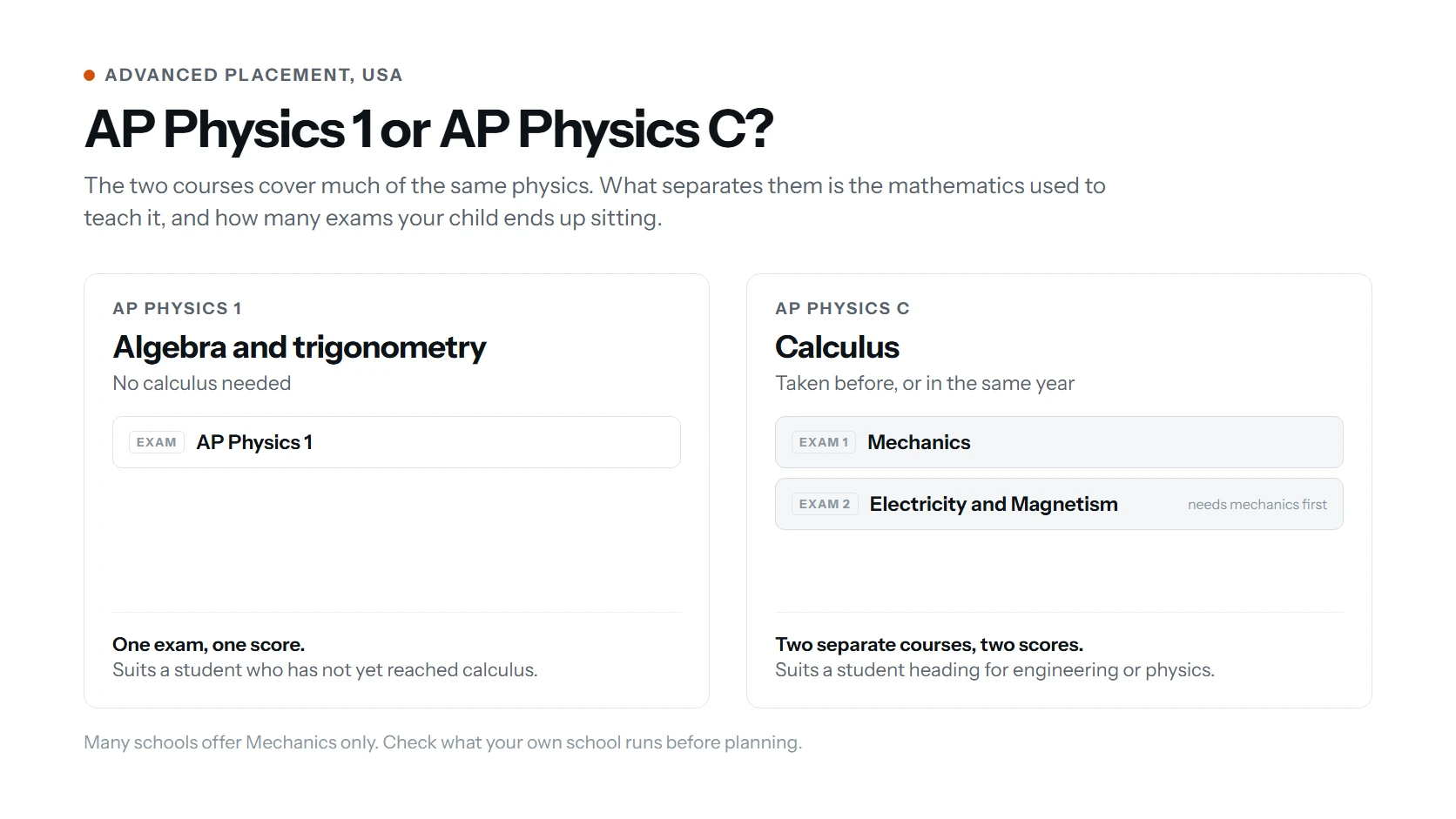
Parents often think AP Physics C is simply the harder version of AP Physics 1. That is not quite right. The two courses cover a lot of the same physics. The real difference is the mathematics used to teach it, and that difference decides who should take which.
The difference in one table
| AP Physics 1 | AP Physics C | |
|---|---|---|
| Mathematics used | Algebra and trigonometry | Calculus |
| Calculus needed first | No | Yes, taken before or in the same year |
| Number of exams | One | Two, Mechanics and Electricity and Magnetism |
| Each exam equals | One semester of introductory algebra-based college physics | One semester of introductory calculus-based college physics |
| Main topics | Kinematics, forces, work and energy, momentum, torque and rotation, oscillations, fluids | Mechanics covers the same ground minus fluids, using calculus. Electricity and Magnetism covers electrostatics, potential, capacitors, circuits, magnetism and induction |
| Credit value | Lower, and at several engineering schools none at all | Higher, because it matches the calculus-based physics that engineering degrees require |
| Suits | A student who has not yet done calculus | A student heading for engineering, physics or another calculus-heavy degree |
A point the table makes that is easy to miss: one Physics C exam is worth the same nominal semester as Physics 1. It is taking both C exams that covers the full two-semester calculus-based sequence an engineering degree expects.
The calculus point, stated plainly
AP Physics 1 is algebra-based. A student learns the formula and applies it.
AP Physics C is calculus-based. The same formulas are derived using differentiation and integration. So a student needs calculus before starting, or at least alongside it in the same academic year.
One clarification that matters. College Board asks for calculus, not specifically AP Calculus. A school’s own calculus course, or a dual enrollment course at a local college, satisfies it just as well. Students at schools that do not offer AP Calculus are not shut out.
This has a practical consequence for scheduling. A student who will only reach calculus in senior year cannot sensibly take Physics C in junior year. The order of courses matters, and it is worth mapping out two years ahead rather than one.
AP Physics C is two courses, and the second has its own prerequisite
This is the detail most families miss, and it has two parts.
AP Physics C: Mechanics and AP Physics C: Electricity and Magnetism are separate courses with separate exams and separate scores. They are now sat on different days.
The second part matters more for planning. Electricity and Magnetism has a mechanics prerequisite of its own. College Board states that a student should have taken Physics C: Mechanics, AP Physics 1, or another mechanics-based physics course before starting it. Being ready in calculus is not enough. A sophomore who has finished calculus still cannot begin with Electricity and Magnetism.
Most students take Mechanics only. In 2025 roughly 66,000 students sat Mechanics against roughly 30,000 for Electricity and Magnetism. Many schools offer Mechanics alone, so find out what your own school actually runs before planning anything.
How the content lines up
Since the 2024 revision the overlap is very close. AP Physics 1 has eight units. Physics C: Mechanics covers seven of them, the same topics, using calculus. The one Physics 1 unit that Mechanics does not cover is fluids.
Electricity and Magnetism is different. It is material Physics 1 does not touch at all: electrostatics, electric potential, capacitors, circuits, magnetic fields and electromagnetic induction. Note that this was not true before 2021, when Physics 1 did include some electricity, so older guides will tell you otherwise.
Taking both courses is normal
Physics 1 in one year and Physics C later is a common and sensible path. It is not repetition of the wasteful kind. Working through the same mechanics with calculus is genuinely different work, and students who do it usually find the second pass much clearer. It also satisfies the mechanics prerequisite for Electricity and Magnetism.
How to decide
- Where is your child in mathematics? If calculus is done or will be done in the same year, Physics C is open. If not, take Physics 1. This single question settles most cases.
- If Electricity and Magnetism is the goal, check the mechanics requirement. Physics 1 or Physics C: Mechanics has to come first. Plan it as a two-year sequence.
- What does your child want to study? Engineering, physics and most physical science degrees expect calculus-based physics. For those, Physics C is the course that counts. For biology, medicine or a non-science degree, Physics 1 is usually enough and the time is better spent elsewhere.
- What will the college actually accept? Credit policy is set by each university, not by College Board, and the differences are large. Some engineering schools award no credit for AP Physics 1 at any score while giving credit for Physics C. Check the policy at the colleges on your child’s list before assuming either course is worth something.
Where students usually struggle
In both courses, marks go on explanation rather than calculation. The free-response questions ask students to justify an answer in words, design an experiment, or translate between a graph, an equation and a description. Students who can solve the problem often cannot say why their method works.
In Physics C there is a second difficulty. A student learning integration in math class while using it in physics is doing two hard things at once. This is normal, and it is the specific thing worth getting help with early rather than late.
Our science tutoring for US students is taught by subject specialists to the AP course framework, at whichever level a student is taking. A free trial class starts with a marked paper, so the discussion afterwards is about the exact place the explanation or the calculus is breaking down. Math tutoring is available alongside it where calculus is the real gap, and the full range is on our USA tutoring page. Families choosing Physics C are usually choosing between AP Calculus AB and BC in the same year.
Course descriptions, prerequisites and current exam formats are published by College Board. Credit policies are published by each university. Confirm both, and check with your school, before making a decision.
Questions parents ask
Does AP Physics C need calculus?
Is AP Physics C one exam or two?
Can a student start with Electricity and Magnetism?
Which one gives more college credit?
Is AP Physics C harder?
See where the explanation stops
Your child explains a topic they have just covered. Where the explanation runs out is the real starting point.
- Free, with no obligation
- A subject specialist, not a generalist
- Marked against the mark scheme
Book a free trial class.
Tell us your child's year group and what they are finding difficult. The last field matters most: a specific worry produces a better tutor match than a subject name.
- A live lesson, not a sales call
- A discussion of the curriculum and your expectations afterwards
- No card details, and nothing starts automatically
Request received
An advisor will email you to confirm a time in your time zone, usually within one working day.