
GCSE Foundation or Higher: what the regulator actually advises
Which GCSE subjects are tiered, what each tier offers, and why Ofqual tells schools that a student expected to get a grade 4 or 5 should sit Foundation. Covers the grade 3 safety net, the unclassified risk, the grade 5 ceiling and when the entry is made.
Most families meet this decision as a letter saying which paper their child has been entered for. It is worth knowing what was decided, and worth knowing that the regulator’s advice on it is the opposite of what a lot of tutoring companies will tell you.
Which subjects are tiered at all
In England, only these:
| Tiered | Single tier |
|---|---|
| Mathematics | English Language |
| Combined Science | English Literature |
| Biology, Chemistry, Physics | History, Geography |
| Statistics | Art, Computer Science and the rest |
| Modern foreign languages |
For everything on the right there is no decision. One paper, full grade range, every student in England sitting the same thing.
Two notes on the left-hand column. Modern foreign languages is not one GCSE but about ten, and combined science exists as two different qualifications depending on the board. And this is England: Wales and Northern Ireland award different qualifications, and WJEC’s GCSE Mathematics and Numeracy is tiered on its own scale, so if you are in Wales none of the grade 4 and 5 detail below is yours.
What each tier offers
In mathematics:
| Foundation | Higher | |
|---|---|---|
| Grades available | 1 to 5 | 4 to 9 |
| If the student falls short | Grade 1, then unclassified | One narrow allowed grade 3, then unclassified |
Combined science works the same way with double grades: Foundation 1-1 to 5-5, Higher 4-4 to 9-9. Its safety net is a 4-3, not a 3-3. A 3-3 was allowed once, exceptionally, in 2018, and Ofqual confirmed it would not be repeated.
The thing to settle first: a grade 4 is a grade 4
This is where most of the anxiety sits, so deal with it before anything else.
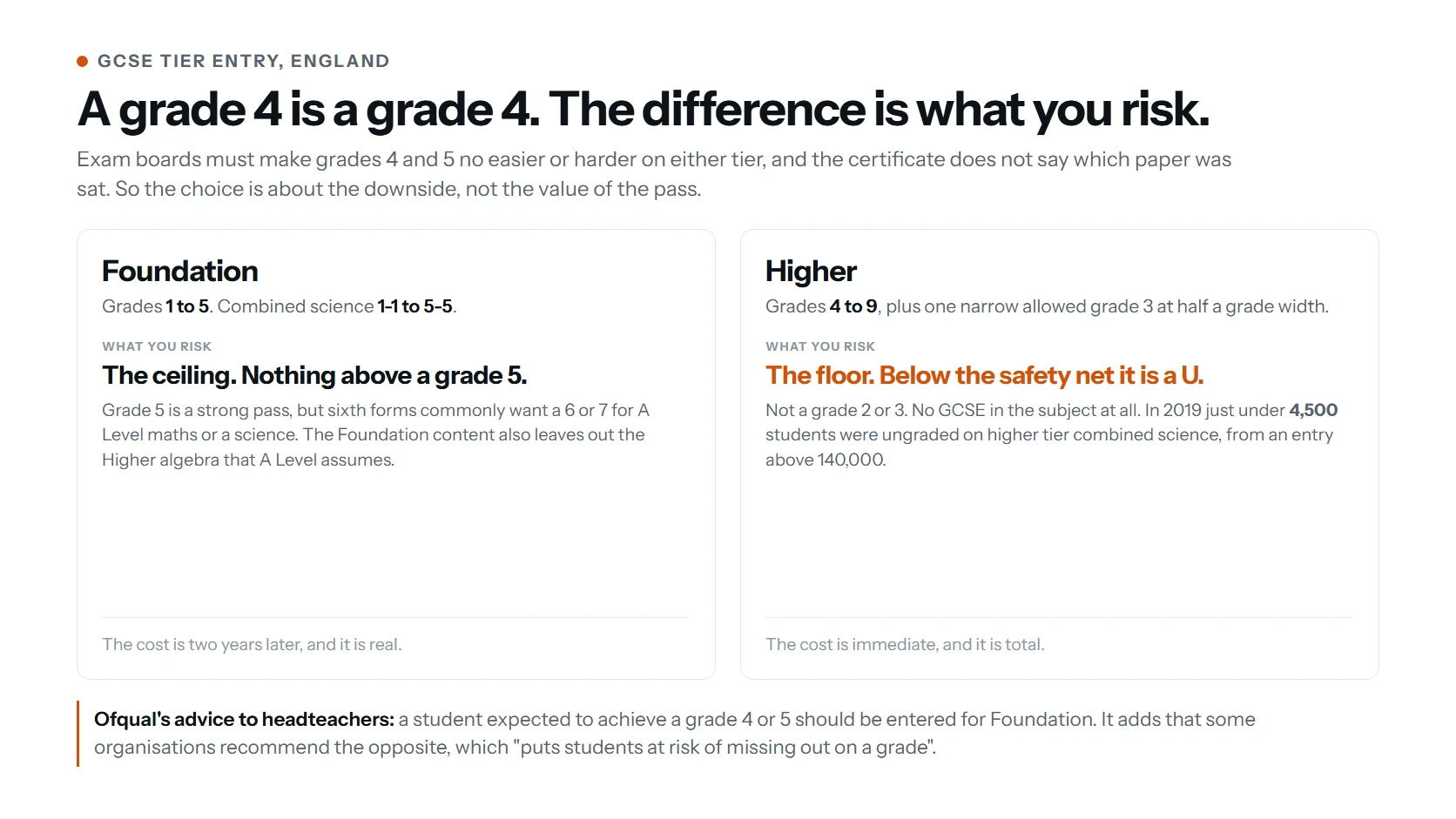
Ofqual’s letter to headteachers puts it plainly: “a grade 4 gained on foundation tier is the same as a grade 4 gained on the higher tier, and this is also the case for grade 5. Exam boards are required to make sure that it is no easier or more difficult to achieve a grade 4 or 5 on higher or foundation tier.” It adds that there is nothing on the certificate showing the tier of entry.
So nobody downstream can tell, and the regulator requires the bar to be level.
You will see the two sets of grade boundaries quoted as if they disproved this. They do not, and it is worth seeing why. These are AQA’s June 2026 mathematics boundaries, out of 240 marks:
| Grade | Foundation | Higher |
|---|---|---|
| 5 | 187 marks (78%) | 97 marks (40%) |
| 4 | 154 marks (64%) | 63 marks (26%) |
| 3 | 115 marks (48%) | 46 marks (19%, the safety net) |
A grade 4 costs two thirds of the Foundation paper and a quarter of the Higher one. That gap is not evidence that Foundation is harder. It is evidence that the papers are different: the Higher paper contains material a grade 4 student has not been taught to handle, so the boundary sits low to compensate. The boards set those boundaries precisely so that the two routes come out level. Comparing raw percentages across two different papers does not measure difficulty, and treating it as though it does is how students end up on the wrong tier.
What Ofqual actually recommends
“a student who is expected to achieve a grade 4 or grade 5 should be entered for foundation tier. We know that some membership organisations recommend the opposite, but that puts students at risk of missing out on a grade.”
That is from the same letter. For combined science the recommendation covers students expected to achieve 4-4 or 5-4.
The reason is the shape of the downside. On Higher, the floor is not a grade 3. It is nothing. The allowed grade 3 is set at half a grade width, deliberately narrow, and a student who drops below it receives a U and holds no GCSE in that subject. In 2019 just under 4,500 students were ungraded on higher tier combined science out of an entry above 140,000, and that was already a big improvement on the year before.
So for a child heading for a 4 or a 5, Foundation gets the same grade with none of that exposure.
The real cost of Foundation, which is not the pass
Foundation’s problem is not the pass, it is the ceiling. Grade 5 is the most that is available.
Grade 5 is a strong pass and clears the post-16 requirement comfortably. What it does not do is reach a 6 or 7, which is what many sixth forms ask for before allowing A Level mathematics or a science. There is no national rule here, every sixth form sets its own, but 6 to 7 for maths and 6, or 6-6 in combined science, is the common range.
And the grade is only half of it. The Foundation specification does not cover the Higher algebra that A Level mathematics assumes. So even a Foundation grade 5 leaves a genuine content gap, not just a number that falls short. That is the honest argument for Higher, and it is a content argument, not a tactical one.
Which gives a clean way to read the decision:
- Realistically heading for a 6 or above, and wanting maths or science at A Level: Higher.
- Realistically heading for a 4 or 5: Foundation, which is what the regulator advises.
- Genuinely borderline between 5 and 6: this is the only hard case, and it deserves a proper conversation with the teacher rather than a rule.
Why grade 4 is the number everyone circles
A grade 4 is a standard pass and a 5 is a strong pass. Grade 4 carries the weight because of what sits below it.
In England, a 16 to 19 year old on a study programme of 150 hours or more who does not hold grade 4 in mathematics, or in English, must keep studying that subject. It is a condition of the college’s funding rather than a duty on the student, and it runs until they achieve the grade. For English, either English Language or English Literature at grade 4 satisfies it. A student at grade 3 must work towards the GCSE itself; one at grade 2 or below may take the GCSE or a level 2 Functional Skills qualification instead.
So the tier decision quietly shapes whether sixth form includes a resit.
When it is decided, and how long you really have
The school decides, normally after the Year 11 mocks, and entries go to the boards by 21 February of the examination year.
A common misunderstanding is that February closes the matter. It does not. Late entry fees from 22 February apply to new entries. Changing the tier of an existing entry is an amendment, and it is free until the amendment deadline, which falls in late April at both AQA and Pearson. So there is a further two months in which a tier can move at no cost.
That said, the useful conversation still happens before the mocks, because the mock paper is the evidence the decision will be made on.
What to actually do
- Ask which tier the school is planning, in the autumn of Year 11. The teachers are usually glad to discuss it, and the mock result is what they will use.
- Ask the sixth form what it requires, if A Level maths or a science is possible. If the answer is a 6, Foundation does not reach it, and that is the one solid reason to take on the Higher risk.
- Judge consistency, not peak marks. A student who scores 70 one week and 30 the next is the risky Higher entry. The regulator’s warning is about exactly that student.
- If the gap is one or two topics, fix those instead of arguing about tier. Most borderline students are not weak across the board; they are missing algebra, or ratio, or graphs, and the same gaps cost marks on either paper.
Getting help
Our maths tutoring for students in the UK covers the GCSE specifications at both tiers, and our science tutoring covers combined and separate sciences. The full range is on the UK tutoring page.
A free trial class starts with your child’s own mock paper, which is the useful thing here: the mock is the evidence the school is using, so reading it properly shows whether the tier is right and which topics would change it.
Tier entry advice is published by Ofqual, entry deadlines by JCQ, and grade boundaries by each exam board. Confirm the tier and the dates with your child’s school, since entries are made by the school rather than the family.
Questions parents ask
Which GCSE subjects have tiers?
Is a grade 4 from Foundation worth less than a grade 4 from Higher?
Which tier does Ofqual recommend?
What happens if my child takes Higher and does badly?
When is the tier decided, and can it be changed?

See the difference in one class
A free trial lesson with a specialist tutor, then a discussion of what the tutor found and your expectations.
- Free, with no obligation
- A tutor matched to the year and subject
- A recommendation you can act on
Book a free trial class.
Tell us your child's year group and what they are finding difficult. The last field matters most: a specific worry produces a better tutor match than a subject name.
- A live lesson, not a sales call
- A discussion of the curriculum and your expectations afterwards
- No card details, and nothing starts automatically
Request received
An advisor will email you to confirm a time in your time zone, usually within one working day.