
SAT or ACT: how to choose
The SAT and the ACT after their recent changes: the adaptive digital SAT against the shorter enhanced ACT with optional Science, the time per question on each, and how to decide which suits your child.
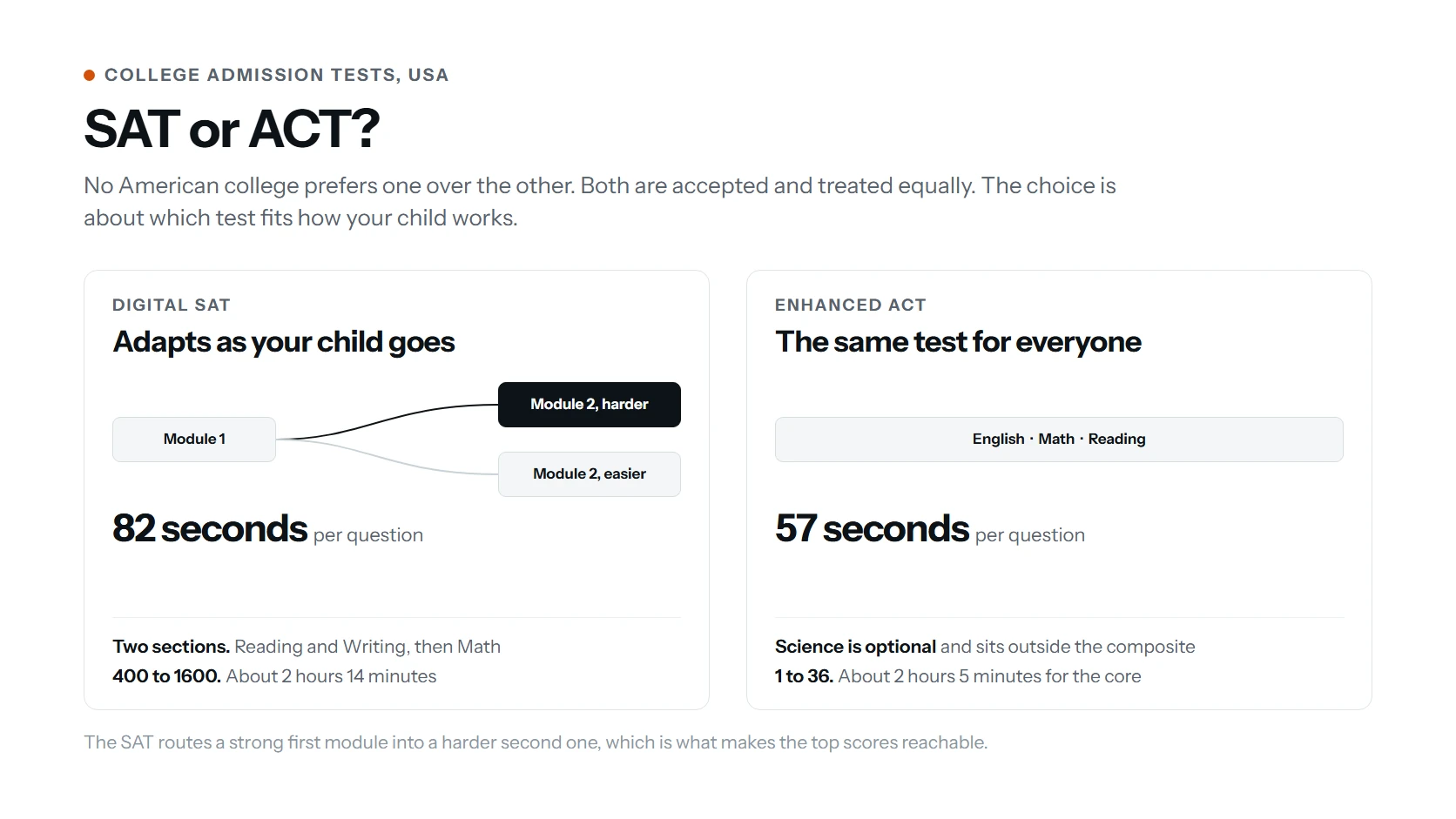
Both tests changed recently, so advice from two or three years ago is now out of date. The SAT is fully digital and adapts to the student as they go. The ACT is shorter than it used to be, and its Science section is no longer part of the main score.
Before anything else, one fact that settles a common worry. No college prefers one test over the other. Every American college that accepts test scores accepts both and treats them the same. The choice is about which test suits your child, nothing more.
The difference in one table
| Digital SAT | Enhanced ACT | |
|---|---|---|
| Format | Fully digital | Paper or digital |
| Adapts to the student | Yes, section-adaptive | No, the same test for everyone |
| Required sections | Reading and Writing, Math | English, Math, Reading |
| Optional sections | None | Science, Writing |
| Core testing time | About 2 hours 14 minutes | About 2 hours 5 minutes |
| Time per question | About 82 seconds | About 57 seconds |
| Score range | 400 to 1600 | 1 to 36 |
| Calculator | Allowed on all Math questions, with one built in | Allowed on the Math section |
What section-adaptive means
This is the SAT’s defining feature and it is widely misunderstood.
Each SAT section is split into two modules. How your child performs on the first module decides which second module they receive. Do well, and the second module is harder. Do less well, and it is easier.
What College Board does not publish is how that routing translates into a score. Its public position is that a student is not advantaged simply by being routed to the harder set. Most test preparation teachers find in practice that the first module matters more than its share of the questions suggests, and it is sensible to treat the opening questions of each section with care. Treat that as practitioner experience, not as an official rule, because College Board has published neither the thresholds nor the score ranges.
What is certain is the mechanism itself: on a linear test an early mistake costs one question, while on the SAT it changes which questions come next.
The ACT does not work this way. It is the same test for every student, whether taken on paper or on screen.
The ACT Science change
Science used to be one of four sections and counted towards the composite score. It is now optional and reported separately. The ACT composite is the average of English, Math and Reading only.
A student who takes Science gets that score reported on its own, and it combines with the Math score to produce a STEM score.
So the old reason for choosing the ACT, that it was the test with a science section, no longer holds in the same way. A student who is strong in science should still consider taking it, because a good STEM score is useful for science and engineering applications. But it is a separate decision now, not part of the main test.
Time pressure is the real difference
Strip away the formats and this is what usually decides it.
The SAT gives roughly 82 seconds per question. The ACT gives roughly 57 seconds. That is a large gap in practice.
A student who understands the material but regularly runs out of time generally does better on the SAT. A student who works quickly and gets restless on long questions often prefers the ACT’s faster rhythm.
This is not something to guess at. It shows up clearly in a timed practice test and nowhere else.
How to decide
- Sit one official practice test of each, timed and in one sitting. Nothing else gives a real answer. Both organisations publish free official practice tests. Take them on separate days.
- Compare the results using a concordance table, not raw scores. A 1300 and a 28 are not obviously comparable. ACT and College Board publish joint concordance tables that convert between the two scales. One caveat worth knowing: those tables date from 2018 and have not been reissued since either test was redesigned. They remain the official comparison because both scales were deliberately kept the same, 400 to 1600 and 1 to 36, but treat the conversion as a guide rather than a precise equivalence.
- Look at how each test felt, not only the score. Did your child run out of time? Did the screen help or distract? A student who dislikes a format will not practise for it willingly over several months.
- Then pick one and stop. Preparing properly for one test beats preparing half-heartedly for two. The gain from switching tests is usually smaller than the gain from eight more weeks of focused practice.
One thing worth knowing about retakes
A second attempt usually helps, but less dramatically than families expect. ACT’s own research on students who retake finds that about 57 in every 100 improve their composite score, around 21 stay the same and around 22 go down, with an average gain of roughly one point. So plan for two sittings from the start, with enough time between them for real work, and do not count on the second sitting to rescue the first. Booking the first test late in senior year leaves no room for either.
Our tutoring for US students covers SAT and ACT preparation alongside school subjects, taught one to one. A free trial class begins with a marked practice section, so the discussion afterwards is about where the marks are actually going, which is usually timing rather than knowledge. Where the underlying subject is the gap, math tutoring and English tutoring are available on their own.
Current formats, dates and official practice material are published by College Board for the SAT and by ACT for the ACT. Both change their tests from time to time, so check the official pages before planning a test year.
Questions parents ask
Do colleges prefer the SAT or the ACT?
Is the ACT Science section still compulsory?
What does section-adaptive mean on the SAT?
Which test gives more time per question?
Can a student take both?



An honest read before the next assessment
One lesson and a written summary of what is actually costing marks, which is rarely what a student thinks it is.
- Free, with no obligation
- Marked practice, not advice
- Something you can act on this week
Book a free trial class.
Tell us your child's year group and what they are finding difficult. The last field matters most: a specific worry produces a better tutor match than a subject name.
- A live lesson, not a sales call
- A discussion of the curriculum and your expectations afterwards
- No card details, and nothing starts automatically
Request received
An advisor will email you to confirm a time in your time zone, usually within one working day.