Abacus Benefits Beyond Maths: Nine Wider Gains
Abacus trains more than arithmetic. Nine wider gains for children, from spatial reasoning and focus to confidence and fine motor control.
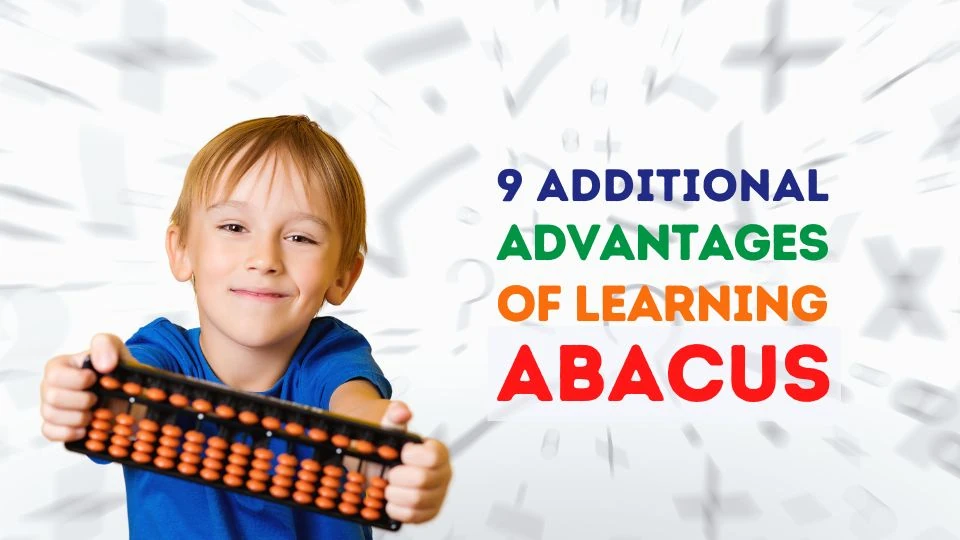
Abacus benefits beyond the arithmetic
Most of what is written about abacus concentrates on calculation: how fast a trained child can add a column of figures, how the mental image of the beads replaces the device. Those gains are real, and they are set out in our article on the five key benefits of learning abacus.
They are also not the whole picture. Parents who stay with the programme past the first few months tend to report changes that have little to do with sums. A child sits with a difficult task for longer. Handwriting steadies. They are less reluctant to attempt something they might get wrong. These are harder to measure than calculation speed, which is probably why they are written about less, but over a couple of years they matter more.
The five commonly cited benefits are the foundation:
-
Focus and concentration
-
Analytical skills
-
Retention
-
Speed, and
-
Visualization skills
Beyond those, nine further gains show up consistently once a child has been practising for a while.
-
Improved spatial reasoning skills: Using an abacus requires kids to visualize and manipulate numbers in their mind, which can improve their spatial reasoning skills. Spatial reasoning is important for a wide range of tasks, from math and science to architecture and engineering.
-
Enhanced mindfulness and focus: Using an abacus requires a lot of concentration and focus, which can help kids develop mindfulness skills. By focusing on the abacus and the numbers they are manipulating, kids can learn to be present in the moment and improve their ability to concentrate on other tasks as well.
-
Boosted creativity: Using an abacus in creative ways can help kids develop their creativity and problem-solving skills. For example, kids could use the abacus to create different patterns or designs, or to solve puzzles and brain teasers.
-
Increased social interaction: Using an abacus in a group setting can help kids improve their social skills by encouraging collaboration and communication. Kids can work together to solve problems and share their ideas with each other, which can help build confidence and develop teamwork skills.
-
Improved hand-eye coordination: Using an abacus requires kids to move beads around with their fingers, which can improve their hand-eye coordination and fine motor skills.
-
Increased cultural awareness: Learning to use an abacus can help kids learn about different cultures and traditions, as the abacus has been used in many different parts of the world for centuries.
-
Greater appreciation for math: By using an abacus to solve math problems, kids can develop a greater appreciation for the subject and see it in a more concrete and tangible way.
-
Enhanced critical thinking: Using an abacus requires kids to think critically and logically, as they must use the beads to solve problems and come up with solutions.
-
Improved confidence and self-esteem: As kids become more proficient in using the abacus, they may feel a sense of accomplishment and pride in their abilities, which can help boost their confidence and self-esteem.
How long before any of this shows
Not immediately, and parents should be sceptical of anyone who promises otherwise. The calculation speed comes first, usually within a term, because it is the thing being drilled. The wider changes follow the habit rather than the skill: they appear once practice has been steady for long enough that sitting down with the beads is simply what happens after school, not a thing to be negotiated. In most families that is somewhere between six months and a year.
They also fade if the practice stops early. Abacus is not a short course that confers permanent benefits; it is a training habit, and the gains described above are the by-product of the habit holding.
What this means when choosing a programme
If the wider benefits are what interest you, two things are worth asking about any abacus class. First, whether the child progresses to mental calculation rather than staying on the physical device, because visualisation is what drives the memory and spatial gains. Second, how much the programme depends on short daily practice at home, since that is where the habit is actually formed. Ten to fifteen minutes, three or four times a week, does more than one long weekend session.
Our abacus programme runs four levels for ages 5 to 14, taught one to one, and the first step is always a free trial class rather than a placement test. Book a free trial class to see how your child takes to it.
Also read: is abacus still relevant in the age of AI?

A real class, not a sales call
The tutor introduces the beads, sees how your child takes to them, and discusses your goals and a schedule with you afterwards.
- Free, with no obligation
- A discussion with you afterwards
- You see the practice set first
Book a free trial class.
Tell us your child's year group and what they are finding difficult. The last field matters most: a specific worry produces a better tutor match than a subject name.
- A live lesson, not a sales call
- A discussion of the curriculum and your expectations afterwards
- No card details, and nothing starts automatically
Request received
An advisor will email you to confirm a time in your time zone, usually within one working day.